

174
G. Lutz and R. Klanner
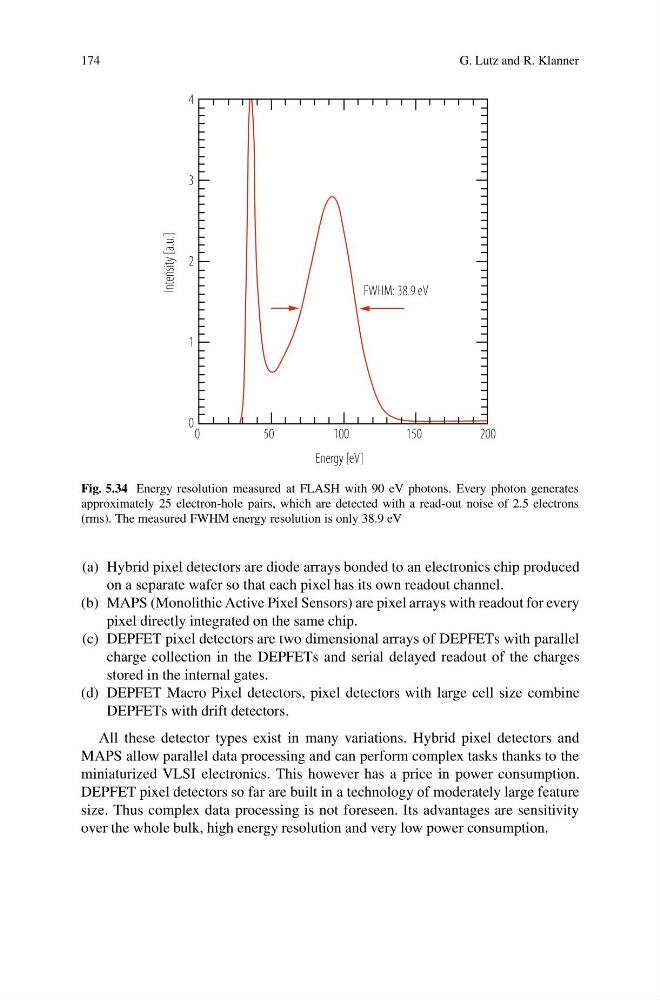
Fig. 5.34 Energy resolution measured at FLASH with 90 eV photons. Every photon generates
approximately 25 electron-hole pairs, which are detected with a read-out noise of 2.5 electrons
(rms). The measured FWHM energy resolution is only 38.9 eV
(a) Hybrid pixel detectors are diode arrays bonded to an electronics chip produced
on a separate wafer so that each pixel has its own readout channel.
(b) MAPS (Monolithic Active Pixel Sensors) are pixel arrays with readout for every
pixel directly integrated on the same chip.
(c) DEPFET pixel detectors are two dimensional arrays of DEPFETs with parallel
charge collection in the DEPFETs and serial delayed readout of the charges
stored in the internal gates.
(d) DEPFET Macro Pixel detectors, pixel detectors with large cell size combine
DEPFETs with drift detectors.
All these detector types exist in many variations. Hybrid pixel detectors and
MAPS allow parallel data processing and can perform complex tasks thanks to the
miniaturized VLSI electronics. This however has a price in power consumption.
DEPFET pixel detectors so far are built in a technology of moderately large feature
size. Thus complex data processing is not foreseen. Its advantages are sensitivity
over the whole bulk, high energy resolution and very low power consumption.
G. Lutz and R. Klanner
Fig. 5.34 Energy resolution measured at FLASH with 90 eV photons. Every photon generates
approximately 25 electron-hole pairs, which are detected with a read-out noise of 2.5 electrons
(rms). The measured FWHM energy resolution is only 38.9 eV
(a) Hybrid pixel detectors are diode arrays bonded to an electronics chip produced
on a separate wafer so that each pixel has its own readout channel.
(b) MAPS (Monolithic Active Pixel Sensors) are pixel arrays with readout for every
pixel directly integrated on the same chip.
(c) DEPFET pixel detectors are two dimensional arrays of DEPFETs with parallel
charge collection in the DEPFETs and serial delayed readout of the charges
stored in the internal gates.
(d) DEPFET Macro Pixel detectors, pixel detectors with large cell size combine
DEPFETs with drift detectors.
All these detector types exist in many variations. Hybrid pixel detectors and
MAPS allow parallel data processing and can perform complex tasks thanks to the
miniaturized VLSI electronics. This however has a price in power consumption.
DEPFET pixel detectors so far are built in a technology of moderately large feature
size. Thus complex data processing is not foreseen. Its advantages are sensitivity
over the whole bulk, high energy resolution and very low power consumption.