

5 Solid State Detectors
173
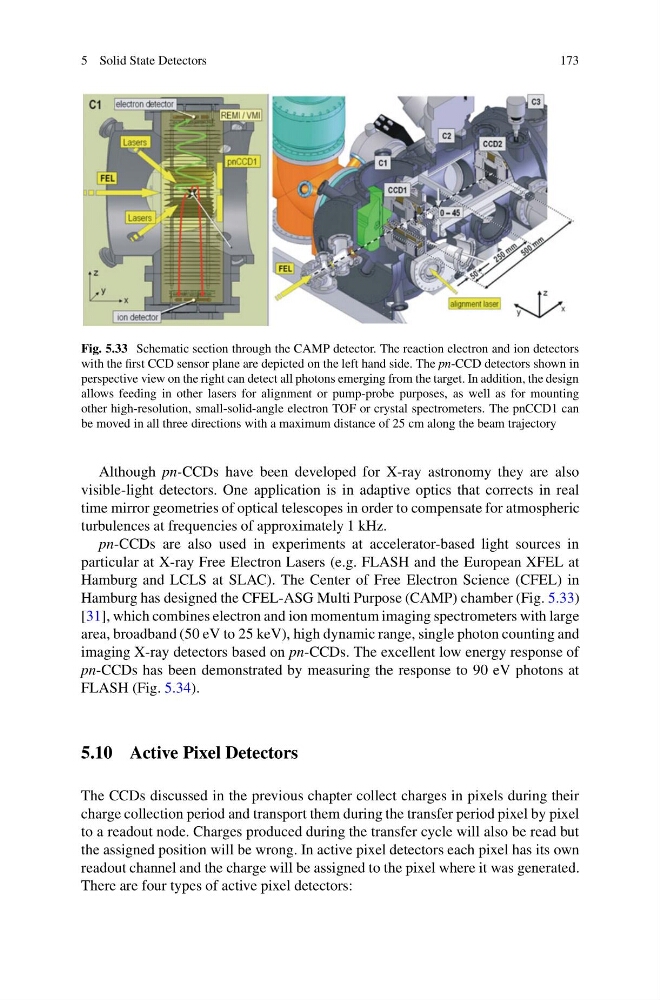
Fig. 5.33 Schematic section through the CAMP detector. The reaction electron and ion detectors
with the first CCD sensor plane are depicted on the left hand side. The pn-CCD detectors shown in
perspective view on the right can detect all photons emerging from the target. In addition, the design
allows feeding in other lasers for alignment or pump-probe purposes, as well as for mounting
other high-resolution, small-solid-angle electron TOF or crystal spectrometers. The pnCCD1 can
be moved in all three directions with a maximum distance of 25 cm along the beam trajectory
Although pn-CCDs have been developed for X-ray astronomy they are also
visible-light detectors. One application is in adaptive optics that corrects in real
time mirror geometries of optical telescopes in order to compensate for atmospheric
turbulences at frequencies of approximately 1 kHz.
pn-CCDs are also used in experiments at accelerator-based light sources in
particular at X-ray Free Electron Lasers (e.g. FLASH and the European XFEL at
Hamburg and LCLS at SLAC). The Center of Free Electron Science (CFEL) in
Hamburg has designed the CFEL-ASG Multi Purpose (CAMP) chamber (Fig. 5.33)
[31], which combines electron and ion momentum imaging spectrometers with large
area, broadband (50 eV to 25 keV), high dynamic range, single photon counting and
imaging X-ray detectors based on pn-CCDs. The excellent low energy response of
pn-CCDs has been demonstrated by measuring the response to 90 eV photons at
FLASH (Fig. 5.34).
5.10 Active Pixel Detectors
The CCDs discussed in the previous chapter collect charges in pixels during their
charge collection period and transport them during the transfer period pixel by pixel
to a readout node. Charges produced during the transfer cycle will also be read but
the assigned position will be wrong. In active pixel detectors each pixel has its own
readout channel and the charge will be assigned to the pixel where it was generated.
There are four types of active pixel detectors:
173
Fig. 5.33 Schematic section through the CAMP detector. The reaction electron and ion detectors
with the first CCD sensor plane are depicted on the left hand side. The pn-CCD detectors shown in
perspective view on the right can detect all photons emerging from the target. In addition, the design
allows feeding in other lasers for alignment or pump-probe purposes, as well as for mounting
other high-resolution, small-solid-angle electron TOF or crystal spectrometers. The pnCCD1 can
be moved in all three directions with a maximum distance of 25 cm along the beam trajectory
Although pn-CCDs have been developed for X-ray astronomy they are also
visible-light detectors. One application is in adaptive optics that corrects in real
time mirror geometries of optical telescopes in order to compensate for atmospheric
turbulences at frequencies of approximately 1 kHz.
pn-CCDs are also used in experiments at accelerator-based light sources in
particular at X-ray Free Electron Lasers (e.g. FLASH and the European XFEL at
Hamburg and LCLS at SLAC). The Center of Free Electron Science (CFEL) in
Hamburg has designed the CFEL-ASG Multi Purpose (CAMP) chamber (Fig. 5.33)
[31], which combines electron and ion momentum imaging spectrometers with large
area, broadband (50 eV to 25 keV), high dynamic range, single photon counting and
imaging X-ray detectors based on pn-CCDs. The excellent low energy response of
pn-CCDs has been demonstrated by measuring the response to 90 eV photons at
FLASH (Fig. 5.34).
5.10 Active Pixel Detectors
The CCDs discussed in the previous chapter collect charges in pixels during their
charge collection period and transport them during the transfer period pixel by pixel
to a readout node. Charges produced during the transfer cycle will also be read but
the assigned position will be wrong. In active pixel detectors each pixel has its own
readout channel and the charge will be assigned to the pixel where it was generated.
There are four types of active pixel detectors: