

172
G. Lutz and R. Klanner
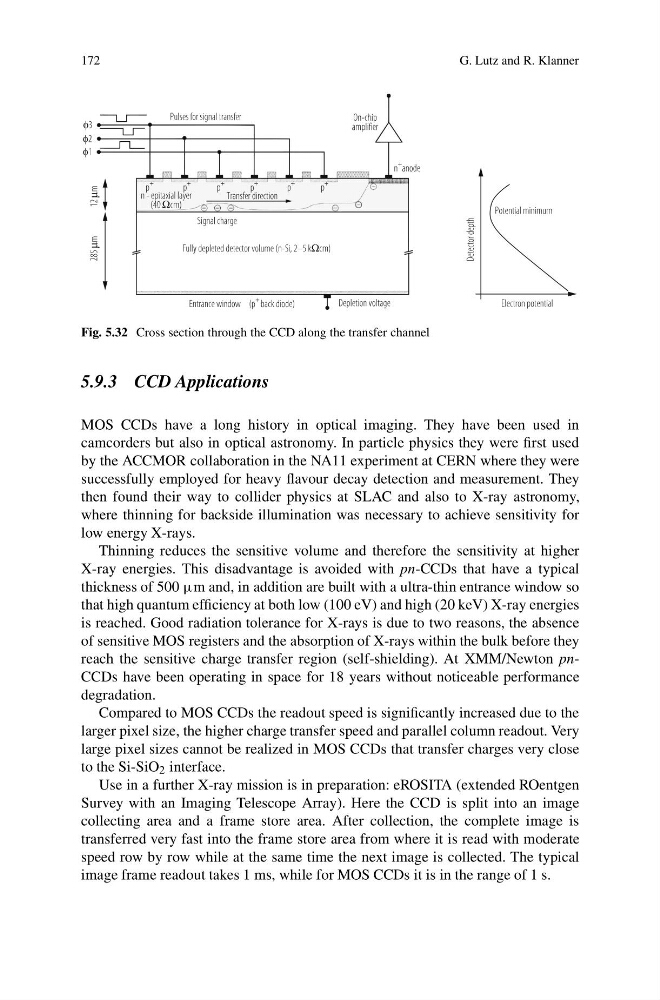
Fig. 5.32 Cross section through the CCD along the transfer channel
5.9.3 CCD Applications
MOS CCDs have a long history in optical imaging. They have been used in
camcorders but also in optical astronomy. In particle physics they were first used
by the ACCMOR collaboration in the NA11 experiment at CERN where they were
successfully employed for heavy flavour decay detection and measurement. They
then found their way to collider physics at SLAC and also to X-ray astronomy,
where thinning for backside illumination was necessary to achieve sensitivity for
low energy X-rays.
Thinning reduces the sensitive volume and therefore the sensitivity at higher
X-ray energies. This disadvantage is avoided with pn-CCDs that have a typical
thickness of 500 μm and, in addition are built with a ultra-thin entrance window so
that high quantum efficiency at both low (100 eV) and high (20 keV) X-ray energies
is reached. Good radiation tolerance for X-rays is due to two reasons, the absence
of sensitive MOS registers and the absorption of X-rays within the bulk before they
reach the sensitive charge transfer region (self-shielding). At XMM/Newton pnCCDs have been operating in space for 18 years without noticeable performance
degradation.
Compared to MOS CCDs the readout speed is significantly increased due to the
larger pixel size, the higher charge transfer speed and parallel column readout. Very
large pixel sizes cannot be realized in MOS CCDs that transfer charges very close
to the Si-SiO 2 interface.
Use in a further X-ray mission is in preparation: eROSITA (extended ROentgen
Survey with an Imaging Telescope Array). Here the CCD is split into an image
collecting area and a frame store area. After collection, the complete image is
transferred very fast into the frame store area from where it is read with moderate
speed row by row while at the same time the next image is collected. The typical
image frame readout takes 1 ms, while for MOS CCDs it is in the range of 1 s.
G. Lutz and R. Klanner
Fig. 5.32 Cross section through the CCD along the transfer channel
5.9.3 CCD Applications
MOS CCDs have a long history in optical imaging. They have been used in
camcorders but also in optical astronomy. In particle physics they were first used
by the ACCMOR collaboration in the NA11 experiment at CERN where they were
successfully employed for heavy flavour decay detection and measurement. They
then found their way to collider physics at SLAC and also to X-ray astronomy,
where thinning for backside illumination was necessary to achieve sensitivity for
low energy X-rays.
Thinning reduces the sensitive volume and therefore the sensitivity at higher
X-ray energies. This disadvantage is avoided with pn-CCDs that have a typical
thickness of 500 μm and, in addition are built with a ultra-thin entrance window so
that high quantum efficiency at both low (100 eV) and high (20 keV) X-ray energies
is reached. Good radiation tolerance for X-rays is due to two reasons, the absence
of sensitive MOS registers and the absorption of X-rays within the bulk before they
reach the sensitive charge transfer region (self-shielding). At XMM/Newton pnCCDs have been operating in space for 18 years without noticeable performance
degradation.
Compared to MOS CCDs the readout speed is significantly increased due to the
larger pixel size, the higher charge transfer speed and parallel column readout. Very
large pixel sizes cannot be realized in MOS CCDs that transfer charges very close
to the Si-SiO 2 interface.
Use in a further X-ray mission is in preparation: eROSITA (extended ROentgen
Survey with an Imaging Telescope Array). Here the CCD is split into an image
collecting area and a frame store area. After collection, the complete image is
transferred very fast into the frame store area from where it is read with moderate
speed row by row while at the same time the next image is collected. The typical
image frame readout takes 1 ms, while for MOS CCDs it is in the range of 1 s.