

4 Gaseous Detectors
133
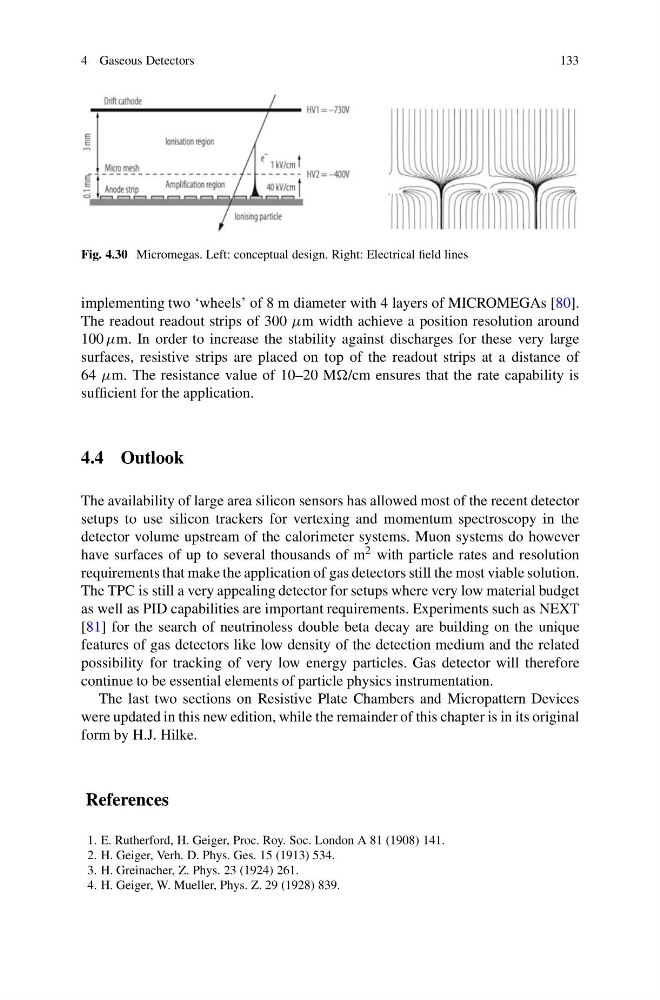
Fig. 4.30 Micromegas. Left: conceptual design. Right: Electrical field lines
implementing two ‘wheels’ of 8 m diameter with 4 layers of MICROMEGAs [80].
The readout readout strips of 300 μm width achieve a position resolution around
100 μm. In order to increase the stability against discharges for these very large
surfaces, resistive strips are placed on top of the readout strips at a distance of
64 μm. The resistance value of 10–20 M/cm ensures that the rate capability is
sufficient for the application.
4.4 Outlook
The availability of large area silicon sensors has allowed most of the recent detector
setups to use silicon trackers for vertexing and momentum spectroscopy in the
detector volume upstream of the calorimeter systems. Muon systems do however
have surfaces of up to several thousands of m 2 with particle rates and resolution
requirements that make the application of gas detectors still the most viable solution.
The TPC is still a very appealing detector for setups where very low material budget
as well as PID capabilities are important requirements. Experiments such as NEXT
[81] for the search of neutrinoless double beta decay are building on the unique
features of gas detectors like low density of the detection medium and the related
possibility for tracking of very low energy particles. Gas detector will therefore
continue to be essential elements of particle physics instrumentation.
The last two sections on Resistive Plate Chambers and Micropattern Devices
were updated in this new edition, while the remainder of this chapter is in its original
form by H.J. Hilke.
References
1. E. Rutherford, H. Geiger, Proc. Roy. Soc. London A 81 (1908) 141.
2. H. Geiger, Verh. D. Phys. Ges. 15 (1913) 534.
3. H. Greinacher, Z. Phys. 23 (1924) 261.
4. H. Geiger, W. Mueller, Phys. Z. 29 (1928) 839.
133
Fig. 4.30 Micromegas. Left: conceptual design. Right: Electrical field lines
implementing two ‘wheels’ of 8 m diameter with 4 layers of MICROMEGAs [80].
The readout readout strips of 300 μm width achieve a position resolution around
100 μm. In order to increase the stability against discharges for these very large
surfaces, resistive strips are placed on top of the readout strips at a distance of
64 μm. The resistance value of 10–20 M/cm ensures that the rate capability is
sufficient for the application.
4.4 Outlook
The availability of large area silicon sensors has allowed most of the recent detector
setups to use silicon trackers for vertexing and momentum spectroscopy in the
detector volume upstream of the calorimeter systems. Muon systems do however
have surfaces of up to several thousands of m 2 with particle rates and resolution
requirements that make the application of gas detectors still the most viable solution.
The TPC is still a very appealing detector for setups where very low material budget
as well as PID capabilities are important requirements. Experiments such as NEXT
[81] for the search of neutrinoless double beta decay are building on the unique
features of gas detectors like low density of the detection medium and the related
possibility for tracking of very low energy particles. Gas detector will therefore
continue to be essential elements of particle physics instrumentation.
The last two sections on Resistive Plate Chambers and Micropattern Devices
were updated in this new edition, while the remainder of this chapter is in its original
form by H.J. Hilke.
References
1. E. Rutherford, H. Geiger, Proc. Roy. Soc. London A 81 (1908) 141.
2. H. Geiger, Verh. D. Phys. Ges. 15 (1913) 534.
3. H. Greinacher, Z. Phys. 23 (1924) 261.
4. H. Geiger, W. Mueller, Phys. Z. 29 (1928) 839.