

132
H. J. Hilke and W. Riegler
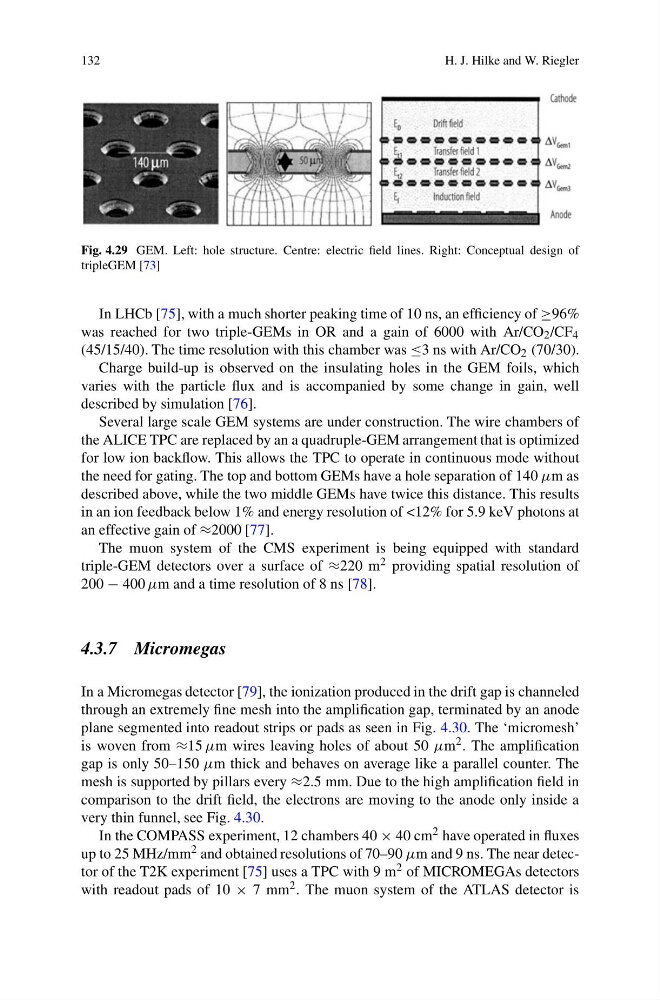
Fig. 4.29 GEM. Left: hole structure. Centre: electric field lines. Right: Conceptual design of
tripleGEM [73]
In LHCb [75], with a much shorter peaking time of 10 ns, an efficiency of ≥96%
was reached for two triple-GEMs in OR and a gain of 6000 with Ar/CO 2 /CF 4
(45/15/40). The time resolution with this chamber was ≤3 ns with Ar/CO 2 (70/30).
Charge build-up is observed on the insulating holes in the GEM foils, which
varies with the particle flux and is accompanied by some change in gain, well
described by simulation [76].
Several large scale GEM systems are under construction. The wire chambers of
the ALICE TPC are replaced by an a quadruple-GEM arrangement that is optimized
for low ion backflow. This allows the TPC to operate in continuous mode without
the need for gating. The top and bottom GEMs have a hole separation of 140 μm as
described above, while the two middle GEMs have twice this distance. This results
in an ion feedback below 1% and energy resolution of <12% for 5.9 keV photons at
an effective gain of ≈2000 [77].
The muon system of the CMS experiment is being equipped with standard
triple-GEM detectors over a surface of ≈220 m 2 providing spatial resolution of
200 − 400 μm and a time resolution of 8 ns [78].
4.3.7 Micromegas
In a Micromegas detector [79], the ionization produced in the drift gap is channeled
through an extremely fine mesh into the amplification gap, terminated by an anode
plane segmented into readout strips or pads as seen in Fig. 4.30. The ‘micromesh’
is woven from ≈15 μm wires leaving holes of about 50 μm 2 . The amplification
gap is only 50–150 μm thick and behaves on average like a parallel counter. The
mesh is supported by pillars every ≈2.5 mm. Due to the high amplification field in
comparison to the drift field, the electrons are moving to the anode only inside a
very thin funnel, see Fig. 4.30.
In the COMPASS experiment, 12 chambers 40 × 40 cm 2 have operated in fluxes
up to 25 MHz/mm 2 and obtained resolutions of 70–90 μm and 9 ns. The near detector of the T2K experiment [75] uses a TPC with 9 m 2 of MICROMEGAs detectors
with readout pads of 10 × 7 mm 2 . The muon system of the ATLAS detector is
H. J. Hilke and W. Riegler
Fig. 4.29 GEM. Left: hole structure. Centre: electric field lines. Right: Conceptual design of
tripleGEM [73]
In LHCb [75], with a much shorter peaking time of 10 ns, an efficiency of ≥96%
was reached for two triple-GEMs in OR and a gain of 6000 with Ar/CO 2 /CF 4
(45/15/40). The time resolution with this chamber was ≤3 ns with Ar/CO 2 (70/30).
Charge build-up is observed on the insulating holes in the GEM foils, which
varies with the particle flux and is accompanied by some change in gain, well
described by simulation [76].
Several large scale GEM systems are under construction. The wire chambers of
the ALICE TPC are replaced by an a quadruple-GEM arrangement that is optimized
for low ion backflow. This allows the TPC to operate in continuous mode without
the need for gating. The top and bottom GEMs have a hole separation of 140 μm as
described above, while the two middle GEMs have twice this distance. This results
in an ion feedback below 1% and energy resolution of <12% for 5.9 keV photons at
an effective gain of ≈2000 [77].
The muon system of the CMS experiment is being equipped with standard
triple-GEM detectors over a surface of ≈220 m 2 providing spatial resolution of
200 − 400 μm and a time resolution of 8 ns [78].
4.3.7 Micromegas
In a Micromegas detector [79], the ionization produced in the drift gap is channeled
through an extremely fine mesh into the amplification gap, terminated by an anode
plane segmented into readout strips or pads as seen in Fig. 4.30. The ‘micromesh’
is woven from ≈15 μm wires leaving holes of about 50 μm 2 . The amplification
gap is only 50–150 μm thick and behaves on average like a parallel counter. The
mesh is supported by pillars every ≈2.5 mm. Due to the high amplification field in
comparison to the drift field, the electrons are moving to the anode only inside a
very thin funnel, see Fig. 4.30.
In the COMPASS experiment, 12 chambers 40 × 40 cm 2 have operated in fluxes
up to 25 MHz/mm 2 and obtained resolutions of 70–90 μm and 9 ns. The near detector of the T2K experiment [75] uses a TPC with 9 m 2 of MICROMEGAs detectors
with readout pads of 10 × 7 mm 2 . The muon system of the ATLAS detector is