

126
H. J. Hilke and W. Riegler
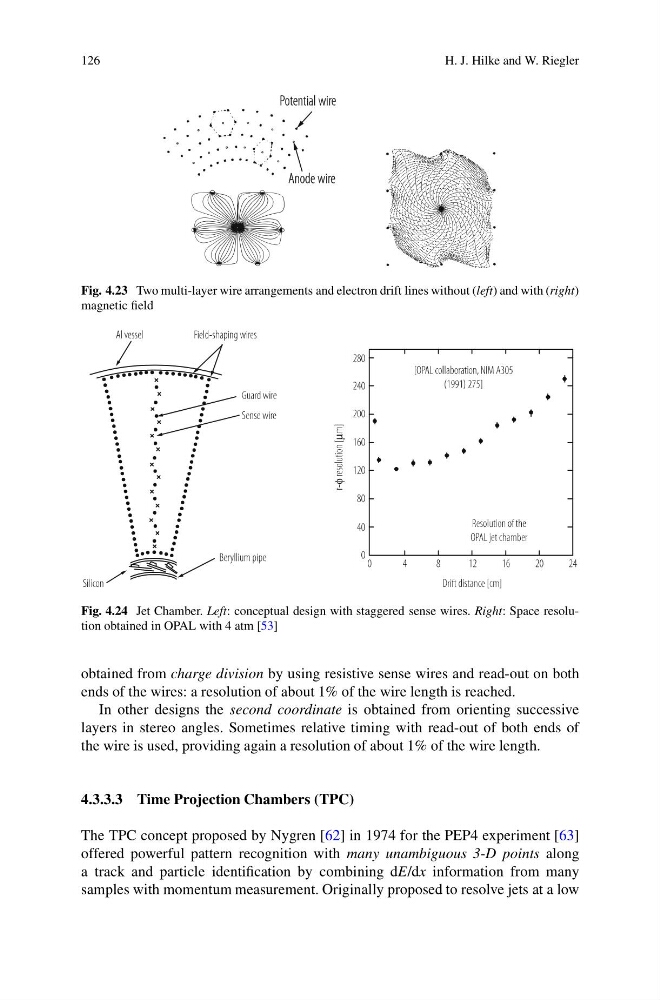
Fig. 4.23 Two multi-layer wire arrangements and electron drift lines without (left) and with (right)
magnetic field
Fig. 4.24 Jet Chamber. Left: conceptual design with staggered sense wires. Right: Space resolution obtained in OPAL with 4 atm [53]
obtained from charge division by using resistive sense wires and read-out on both
ends of the wires: a resolution of about 1% of the wire length is reached.
In other designs the second coordinate is obtained from orienting successive
layers in stereo angles. Sometimes relative timing with read-out of both ends of
the wire is used, providing again a resolution of about 1% of the wire length.
4.3.3.3 Time Projection Chambers (TPC)
The TPC concept proposed by Nygren [62] in 1974 for the PEP4 experiment [63]
offered powerful pattern recognition with many unambiguous 3-D points along
a track and particle identification by combining dE/dx information from many
samples with momentum measurement. Originally proposed to resolve jets at a low
H. J. Hilke and W. Riegler
Fig. 4.23 Two multi-layer wire arrangements and electron drift lines without (left) and with (right)
magnetic field
Fig. 4.24 Jet Chamber. Left: conceptual design with staggered sense wires. Right: Space resolution obtained in OPAL with 4 atm [53]
obtained from charge division by using resistive sense wires and read-out on both
ends of the wires: a resolution of about 1% of the wire length is reached.
In other designs the second coordinate is obtained from orienting successive
layers in stereo angles. Sometimes relative timing with read-out of both ends of
the wire is used, providing again a resolution of about 1% of the wire length.
4.3.3.3 Time Projection Chambers (TPC)
The TPC concept proposed by Nygren [62] in 1974 for the PEP4 experiment [63]
offered powerful pattern recognition with many unambiguous 3-D points along
a track and particle identification by combining dE/dx information from many
samples with momentum measurement. Originally proposed to resolve jets at a low