

4 Gaseous Detectors
127
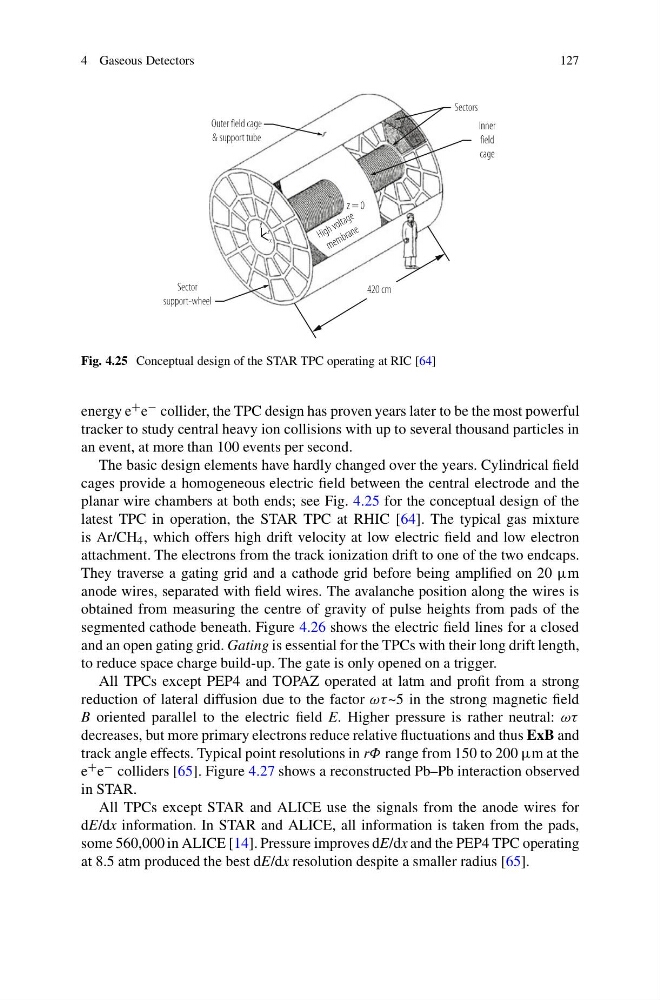
Fig. 4.25 Conceptual design of the STAR TPC operating at RIC [64]
energy e + e − collider, the TPC design has proven years later to be the most powerful
tracker to study central heavy ion collisions with up to several thousand particles in
an event, at more than 100 events per second.
The basic design elements have hardly changed over the years. Cylindrical field
cages provide a homogeneous electric field between the central electrode and the
planar wire chambers at both ends; see Fig. 4.25 for the conceptual design of the
latest TPC in operation, the STAR TPC at RHIC [64]. The typical gas mixture
is Ar/CH 4 , which offers high drift velocity at low electric field and low electron
attachment. The electrons from the track ionization drift to one of the two endcaps.
They traverse a gating grid and a cathode grid before being amplified on 20 μm
anode wires, separated with field wires. The avalanche position along the wires is
obtained from measuring the centre of gravity of pulse heights from pads of the
segmented cathode beneath. Figure 4.26 shows the electric field lines for a closed
and an open gating grid. Gating is essential for the TPCs with their long drift length,
to reduce space charge build-up. The gate is only opened on a trigger.
All TPCs except PEP4 and TOPAZ operated at latm and profit from a strong
reduction of lateral diffusion due to the factor ωτ ~5 in the strong magnetic field
B oriented parallel to the electric field E. Higher pressure is rather neutral: ωτ
decreases, but more primary electrons reduce relative fluctuations and thus ExB and
track angle effects. Typical point resolutions in rΦ range from 150 to 200 μm at the
e + e − colliders [65]. Figure 4.27 shows a reconstructed Pb–Pb interaction observed
in STAR.
All TPCs except STAR and ALICE use the signals from the anode wires for
dE/dx information. In STAR and ALICE, all information is taken from the pads,
some 560,000 in ALICE [14]. Pressure improves dE/dx and the PEP4 TPC operating
at 8.5 atm produced the best dE/dx resolution despite a smaller radius [65].
127
Fig. 4.25 Conceptual design of the STAR TPC operating at RIC [64]
energy e + e − collider, the TPC design has proven years later to be the most powerful
tracker to study central heavy ion collisions with up to several thousand particles in
an event, at more than 100 events per second.
The basic design elements have hardly changed over the years. Cylindrical field
cages provide a homogeneous electric field between the central electrode and the
planar wire chambers at both ends; see Fig. 4.25 for the conceptual design of the
latest TPC in operation, the STAR TPC at RHIC [64]. The typical gas mixture
is Ar/CH 4 , which offers high drift velocity at low electric field and low electron
attachment. The electrons from the track ionization drift to one of the two endcaps.
They traverse a gating grid and a cathode grid before being amplified on 20 μm
anode wires, separated with field wires. The avalanche position along the wires is
obtained from measuring the centre of gravity of pulse heights from pads of the
segmented cathode beneath. Figure 4.26 shows the electric field lines for a closed
and an open gating grid. Gating is essential for the TPCs with their long drift length,
to reduce space charge build-up. The gate is only opened on a trigger.
All TPCs except PEP4 and TOPAZ operated at latm and profit from a strong
reduction of lateral diffusion due to the factor ωτ ~5 in the strong magnetic field
B oriented parallel to the electric field E. Higher pressure is rather neutral: ωτ
decreases, but more primary electrons reduce relative fluctuations and thus ExB and
track angle effects. Typical point resolutions in rΦ range from 150 to 200 μm at the
e + e − colliders [65]. Figure 4.27 shows a reconstructed Pb–Pb interaction observed
in STAR.
All TPCs except STAR and ALICE use the signals from the anode wires for
dE/dx information. In STAR and ALICE, all information is taken from the pads,
some 560,000 in ALICE [14]. Pressure improves dE/dx and the PEP4 TPC operating
at 8.5 atm produced the best dE/dx resolution despite a smaller radius [65].