

116
H. J. Hilke and W. Riegler
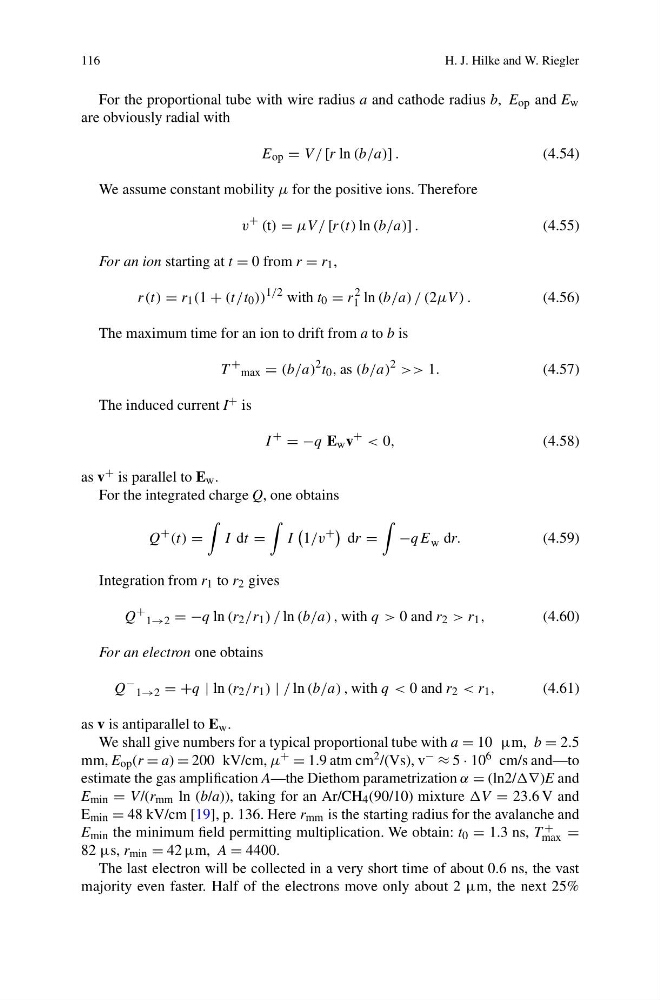
For the proportional tube with wire radius a and cathode radius b, E op and E w
are obviously radial with
E op = V / [r ln (b/a)] .
(4.54)
We assume constant mobility μ for the positive ions. Therefore
v
+ (t) = μV / [r(t) ln (b/a)] .
(4.55)
For an ion starting at t = 0 from r = r 1 ,
r(t) = r 1 (1 + (t/t 0 ))
1/2 with t 0 = r
2
1 ln (b/a) / (2μV ) .
(4.56)
The maximum time for an ion to drift from a to b is
T
+
max = (b/a)
2 t 0 , as (b/a)
2 >> 1.
(4.57)
The induced current I + is
I
+
= −q E w v
+ < 0,
(4.58)
as v + is parallel to E w .
For the integrated charge Q, one obtains
Q
+ (t) =
I dt =
I
1/v
+
dr =
−qE w dr.
(4.59)
Integration from r 1 to r 2 gives
Q
+
1→2 = −q ln (r 2 /r 1 ) / ln (b/a) , with q > 0 and r 2 > r 1 ,
(4.60)
For an electron one obtains
Q
−
1→2 = +q | ln (r 2 /r 1 ) | / ln (b/a) , with q < 0 and r 2 < r 1 ,
(4.61)
as v is antiparallel to E w .
We shall give numbers for a typical proportional tube with a = 10 μm, b = 2.5
mm, E op (r = a) = 200 kV/cm, μ + = 1.9 atm cm 2 /(Vs), v − ≈ 5 · 10 6 cm/s and—to
estimate the gas amplification A—the Diethom parametrization α = (ln2/∇)E and
E min = V/(r mm ln (b/a)), taking for an Ar/CH 4 (90/10) mixture V = 23.6 V and
E min = 48 kV/cm [19], p. 136. Here r mm is the starting radius for the avalanche and
E min the minimum field permitting multiplication. We obtain: t 0 = 1.3 ns, T +
max =
82 μs, r min = 42 μm, A = 4400.
The last electron will be collected in a very short time of about 0.6 ns, the vast
majority even faster. Half of the electrons move only about 2 μm, the next 25%
H. J. Hilke and W. Riegler
For the proportional tube with wire radius a and cathode radius b, E op and E w
are obviously radial with
E op = V / [r ln (b/a)] .
(4.54)
We assume constant mobility μ for the positive ions. Therefore
v
+ (t) = μV / [r(t) ln (b/a)] .
(4.55)
For an ion starting at t = 0 from r = r 1 ,
r(t) = r 1 (1 + (t/t 0 ))
1/2 with t 0 = r
2
1 ln (b/a) / (2μV ) .
(4.56)
The maximum time for an ion to drift from a to b is
T
+
max = (b/a)
2 t 0 , as (b/a)
2 >> 1.
(4.57)
The induced current I + is
I
+
= −q E w v
+ < 0,
(4.58)
as v + is parallel to E w .
For the integrated charge Q, one obtains
Q
+ (t) =
I dt =
I
1/v
+
dr =
−qE w dr.
(4.59)
Integration from r 1 to r 2 gives
Q
+
1→2 = −q ln (r 2 /r 1 ) / ln (b/a) , with q > 0 and r 2 > r 1 ,
(4.60)
For an electron one obtains
Q
−
1→2 = +q | ln (r 2 /r 1 ) | / ln (b/a) , with q < 0 and r 2 < r 1 ,
(4.61)
as v is antiparallel to E w .
We shall give numbers for a typical proportional tube with a = 10 μm, b = 2.5
mm, E op (r = a) = 200 kV/cm, μ + = 1.9 atm cm 2 /(Vs), v − ≈ 5 · 10 6 cm/s and—to
estimate the gas amplification A—the Diethom parametrization α = (ln2/∇)E and
E min = V/(r mm ln (b/a)), taking for an Ar/CH 4 (90/10) mixture V = 23.6 V and
E min = 48 kV/cm [19], p. 136. Here r mm is the starting radius for the avalanche and
E min the minimum field permitting multiplication. We obtain: t 0 = 1.3 ns, T +
max =
82 μs, r min = 42 μm, A = 4400.
The last electron will be collected in a very short time of about 0.6 ns, the vast
majority even faster. Half of the electrons move only about 2 μm, the next 25%