

4 Gaseous Detectors
115
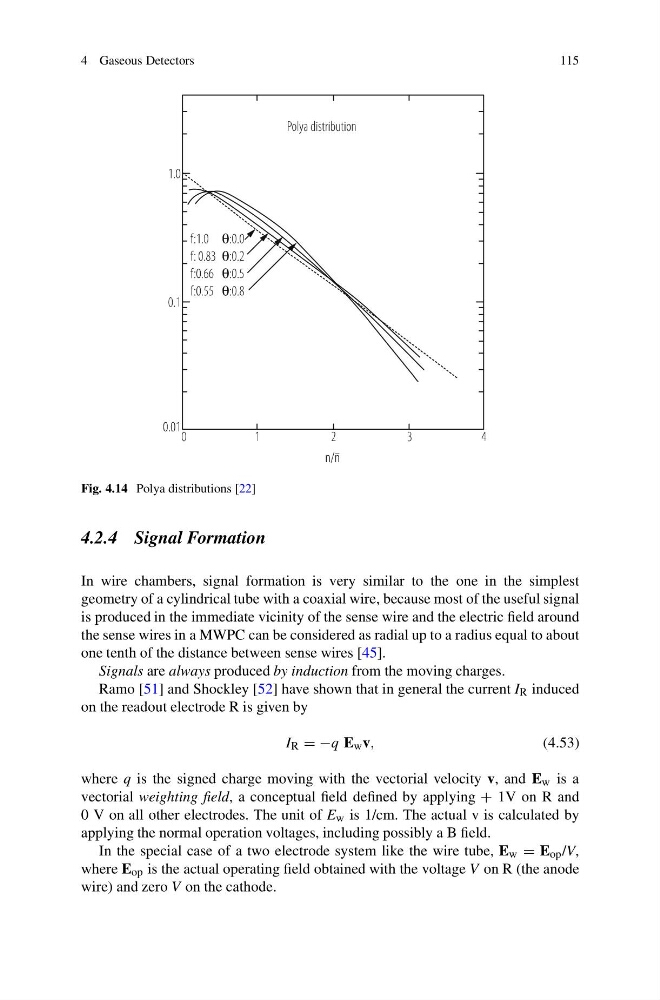
Fig. 4.14 Polya distributions [22]
4.2.4 Signal Formation
In wire chambers, signal formation is very similar to the one in the simplest
geometry of a cylindrical tube with a coaxial wire, because most of the useful signal
is produced in the immediate vicinity of the sense wire and the electric field around
the sense wires in a MWPC can be considered as radial up to a radius equal to about
one tenth of the distance between sense wires [45].
Signals are always produced by induction from the moving charges.
Ramo [51] and Shockley [52] have shown that in general the current I R induced
on the readout electrode R is given by
I R = −q E w v,
(4.53)
where q is the signed charge moving with the vectorial velocity v, and E w is a
vectorial weighting field, a conceptual field defined by applying + 1V on R and
0 V on all other electrodes. The unit of E w is 1/cm. The actual v is calculated by
applying the normal operation voltages, including possibly a B field.
In the special case of a two electrode system like the wire tube, E w = E op /V,
where E op is the actual operating field obtained with the voltage V on R (the anode
wire) and zero V on the cathode.
115
Fig. 4.14 Polya distributions [22]
4.2.4 Signal Formation
In wire chambers, signal formation is very similar to the one in the simplest
geometry of a cylindrical tube with a coaxial wire, because most of the useful signal
is produced in the immediate vicinity of the sense wire and the electric field around
the sense wires in a MWPC can be considered as radial up to a radius equal to about
one tenth of the distance between sense wires [45].
Signals are always produced by induction from the moving charges.
Ramo [51] and Shockley [52] have shown that in general the current I R induced
on the readout electrode R is given by
I R = −q E w v,
(4.53)
where q is the signed charge moving with the vectorial velocity v, and E w is a
vectorial weighting field, a conceptual field defined by applying + 1V on R and
0 V on all other electrodes. The unit of E w is 1/cm. The actual v is calculated by
applying the normal operation voltages, including possibly a B field.
In the special case of a two electrode system like the wire tube, E w = E op /V,
where E op is the actual operating field obtained with the voltage V on R (the anode
wire) and zero V on the cathode.