

104
H. J. Hilke and W. Riegler
Two special cases are of practical interest for electron drift:
E orthogonal to B
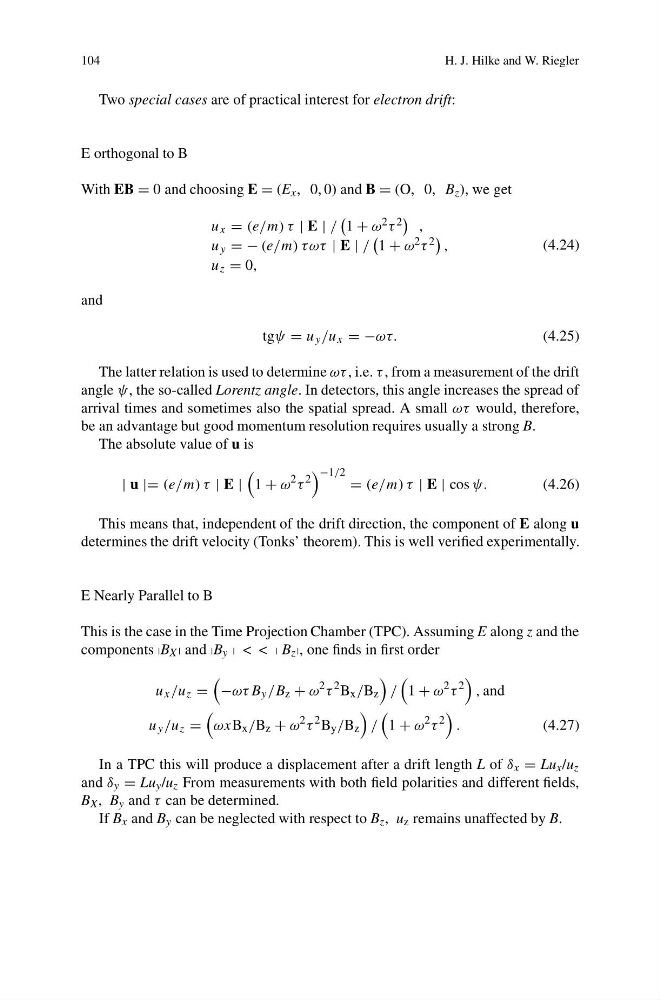
With EB = 0 and choosing E = (E x , 0,0) and B = (O, 0, B z ), we get
u x = (e/m) τ | E | /
1 + ω 2 τ 2
,
u y = − (e/m) τ ωτ | E | /
1 + ω 2 τ 2
,
u z = 0,
(4.24)
and
tgψ = u y /u x = −ωτ.
(4.25)
The latter relation is used to determine ωτ , i.e. τ , from a measurement of the drift
angle ψ, the so-called Lorentz angle. In detectors, this angle increases the spread of
arrival times and sometimes also the spatial spread. A small ωτ would, therefore,
be an advantage but good momentum resolution requires usually a strong B.
The absolute value of u is
| u |= (e/m) τ | E |
1 + ω
2 τ
2
−1/2 = (e/m) τ | E | cos ψ.
(4.26)
This means that, independent of the drift direction, the component of E along u
determines the drift velocity (Tonks’ theorem). This is well verified experimentally.
E Nearly Parallel to B
This is the case in the Time Projection Chamber (TPC). Assuming E along z and the
components B X and B y < < B z , one finds in first order
u x /u z =
−ωτ B y /B z + ω
2 τ
2 B x /B z
/
1 + ω
2 τ
2
, and
u y /u z =
ωxB x /B z + ω
2 τ
2 B y /B z
/
1 + ω
2 τ
2
.
(4.27)
In a TPC this will produce a displacement after a drift length L of δ x = Lu x /u z
and δ y = Lu y /u z From measurements with both field polarities and different fields,
B X , B y and τ can be determined.
If B x and B y can be neglected with respect to B z , u z remains unaffected by B.
H. J. Hilke and W. Riegler
Two special cases are of practical interest for electron drift:
E orthogonal to B
With EB = 0 and choosing E = (E x , 0,0) and B = (O, 0, B z ), we get
u x = (e/m) τ | E | /
1 + ω 2 τ 2
,
u y = − (e/m) τ ωτ | E | /
1 + ω 2 τ 2
,
u z = 0,
(4.24)
and
tgψ = u y /u x = −ωτ.
(4.25)
The latter relation is used to determine ωτ , i.e. τ , from a measurement of the drift
angle ψ, the so-called Lorentz angle. In detectors, this angle increases the spread of
arrival times and sometimes also the spatial spread. A small ωτ would, therefore,
be an advantage but good momentum resolution requires usually a strong B.
The absolute value of u is
| u |= (e/m) τ | E |
1 + ω
2 τ
2
−1/2 = (e/m) τ | E | cos ψ.
(4.26)
This means that, independent of the drift direction, the component of E along u
determines the drift velocity (Tonks’ theorem). This is well verified experimentally.
E Nearly Parallel to B
This is the case in the Time Projection Chamber (TPC). Assuming E along z and the
components B X and B y < < B z , one finds in first order
u x /u z =
−ωτ B y /B z + ω
2 τ
2 B x /B z
/
1 + ω
2 τ
2
, and
u y /u z =
ωxB x /B z + ω
2 τ
2 B y /B z
/
1 + ω
2 τ
2
.
(4.27)
In a TPC this will produce a displacement after a drift length L of δ x = Lu x /u z
and δ y = Lu y /u z From measurements with both field polarities and different fields,
B X , B y and τ can be determined.
If B x and B y can be neglected with respect to B z , u z remains unaffected by B.