

4 Gaseous Detectors
103
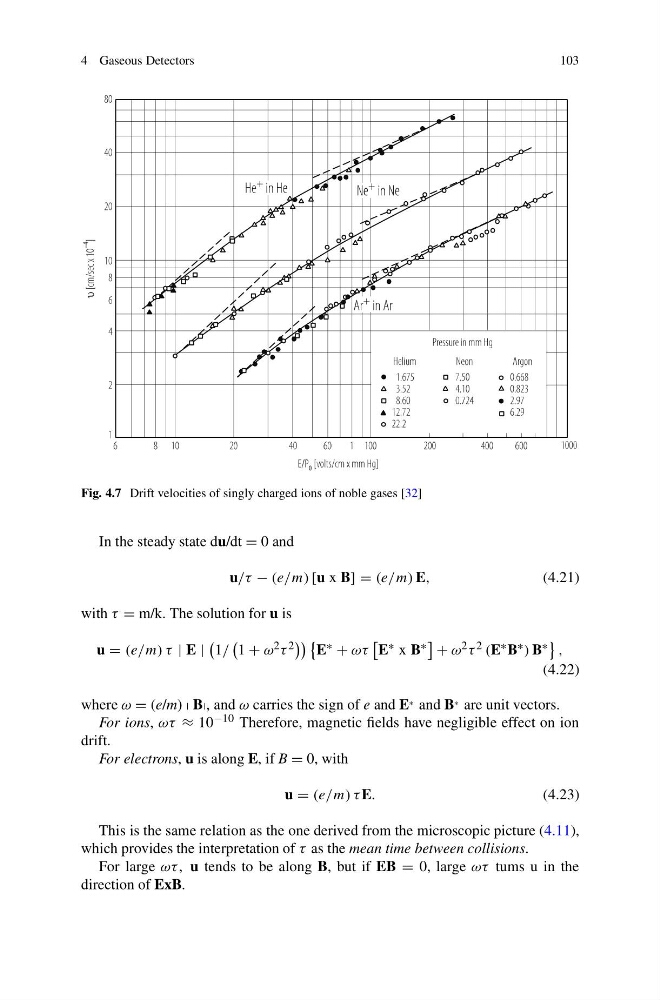
Fig. 4.7 Drift velocities of singly charged ions of noble gases [32]
In the steady state du/dt = 0 and
u/τ − (e/m) [u x B] = (e/m) E,
(4.21)
with τ = m/k. The solution for u is
u = (e/m) τ | E |
1/
1 + ω 2 τ 2
E ∗ + ωτ
E ∗ x B ∗ + ω 2 τ 2 (E ∗ B ∗ ) B ∗
,
(4.22)
where ω = (e/m) B, and ω carries the sign of e and E ∗ and B ∗ are unit vectors.
For ions, ωτ ≈ 10 −10 Therefore, magnetic fields have negligible effect on ion
drift.
For electrons, u is along E, if B = 0, with
u = (e/m) τ E.
(4.23)
This is the same relation as the one derived from the microscopic picture (4.11),
which provides the interpretation of τ as the mean time between collisions.
For large ωτ , u tends to be along B, but if EB = 0, large ωτ tums u in the
direction of ExB.
103
Fig. 4.7 Drift velocities of singly charged ions of noble gases [32]
In the steady state du/dt = 0 and
u/τ − (e/m) [u x B] = (e/m) E,
(4.21)
with τ = m/k. The solution for u is
u = (e/m) τ | E |
1/
1 + ω 2 τ 2
E ∗ + ωτ
E ∗ x B ∗ + ω 2 τ 2 (E ∗ B ∗ ) B ∗
,
(4.22)
where ω = (e/m) B, and ω carries the sign of e and E ∗ and B ∗ are unit vectors.
For ions, ωτ ≈ 10 −10 Therefore, magnetic fields have negligible effect on ion
drift.
For electrons, u is along E, if B = 0, with
u = (e/m) τ E.
(4.23)
This is the same relation as the one derived from the microscopic picture (4.11),
which provides the interpretation of τ as the mean time between collisions.
For large ωτ , u tends to be along B, but if EB = 0, large ωτ tums u in the
direction of ExB.