

102
H. J. Hilke and W. Riegler
Drift of Ions
Ions of mass m i acquire the same amount of energy between two collisions as
electrons but they lose a large fraction of it in the next collision and their random
energy thus remains close to thermal energy. On the other hand the direction of their
motion is largely maintained. The result is a much smaller diffusion compared to
electrons and constant mobility up to high fields (to ~20 kV/cm atm for A + ions in
A). In the approximation for low E field, the random velocity is considered thermal,
i.e. the relative velocity c re1 between the ion and the gas molecules of mass M, which
determines τ , is
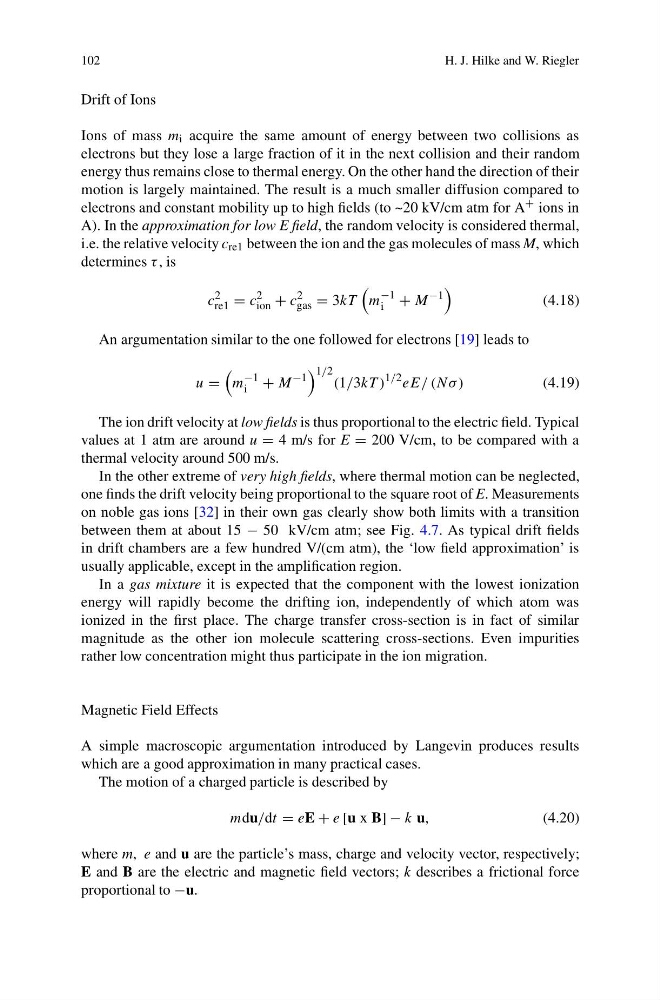
c
2
re1 = c
2
ion + c
2
gas = 3kT
m
−1
i + M
−1
(4.18)
An argumentation similar to the one followed for electrons [19] leads to
u =
m
−1
i + M
−1
1/2
(1/3kT )
1/2 eE/ (Nσ )
(4.19)
The ion drift velocity at low fields is thus proportional to the electric field. Typical
values at 1 atm are around u = 4 m/s for E = 200 V/cm, to be compared with a
thermal velocity around 500 m/s.
In the other extreme of very high fields, where thermal motion can be neglected,
one finds the drift velocity being proportional to the square root of E. Measurements
on noble gas ions [32] in their own gas clearly show both limits with a transition
between them at about 15 − 50 kV/cm atm; see Fig. 4.7. As typical drift fields
in drift chambers are a few hundred V/(cm atm), the ‘low field approximation’ is
usually applicable, except in the amplification region.
In a gas mixture it is expected that the component with the lowest ionization
energy will rapidly become the drifting ion, independently of which atom was
ionized in the first place. The charge transfer cross-section is in fact of similar
magnitude as the other ion molecule scattering cross-sections. Even impurities
rather low concentration might thus participate in the ion migration.
Magnetic Field Effects
A simple macroscopic argumentation introduced by Langevin produces results
which are a good approximation in many practical cases.
The motion of a charged particle is described by
mdu/dt = eE + e [u x B] − k u,
(4.20)
where m, e and u are the particle’s mass, charge and velocity vector, respectively;
E and B are the electric and magnetic field vectors; k describes a frictional force
proportional to −u.
H. J. Hilke and W. Riegler
Drift of Ions
Ions of mass m i acquire the same amount of energy between two collisions as
electrons but they lose a large fraction of it in the next collision and their random
energy thus remains close to thermal energy. On the other hand the direction of their
motion is largely maintained. The result is a much smaller diffusion compared to
electrons and constant mobility up to high fields (to ~20 kV/cm atm for A + ions in
A). In the approximation for low E field, the random velocity is considered thermal,
i.e. the relative velocity c re1 between the ion and the gas molecules of mass M, which
determines τ , is
c
2
re1 = c
2
ion + c
2
gas = 3kT
m
−1
i + M
−1
(4.18)
An argumentation similar to the one followed for electrons [19] leads to
u =
m
−1
i + M
−1
1/2
(1/3kT )
1/2 eE/ (Nσ )
(4.19)
The ion drift velocity at low fields is thus proportional to the electric field. Typical
values at 1 atm are around u = 4 m/s for E = 200 V/cm, to be compared with a
thermal velocity around 500 m/s.
In the other extreme of very high fields, where thermal motion can be neglected,
one finds the drift velocity being proportional to the square root of E. Measurements
on noble gas ions [32] in their own gas clearly show both limits with a transition
between them at about 15 − 50 kV/cm atm; see Fig. 4.7. As typical drift fields
in drift chambers are a few hundred V/(cm atm), the ‘low field approximation’ is
usually applicable, except in the amplification region.
In a gas mixture it is expected that the component with the lowest ionization
energy will rapidly become the drifting ion, independently of which atom was
ionized in the first place. The charge transfer cross-section is in fact of similar
magnitude as the other ion molecule scattering cross-sections. Even impurities
rather low concentration might thus participate in the ion migration.
Magnetic Field Effects
A simple macroscopic argumentation introduced by Langevin produces results
which are a good approximation in many practical cases.
The motion of a charged particle is described by
mdu/dt = eE + e [u x B] − k u,
(4.20)
where m, e and u are the particle’s mass, charge and velocity vector, respectively;
E and B are the electric and magnetic field vectors; k describes a frictional force
proportional to −u.