

4 Gaseous Detectors
101
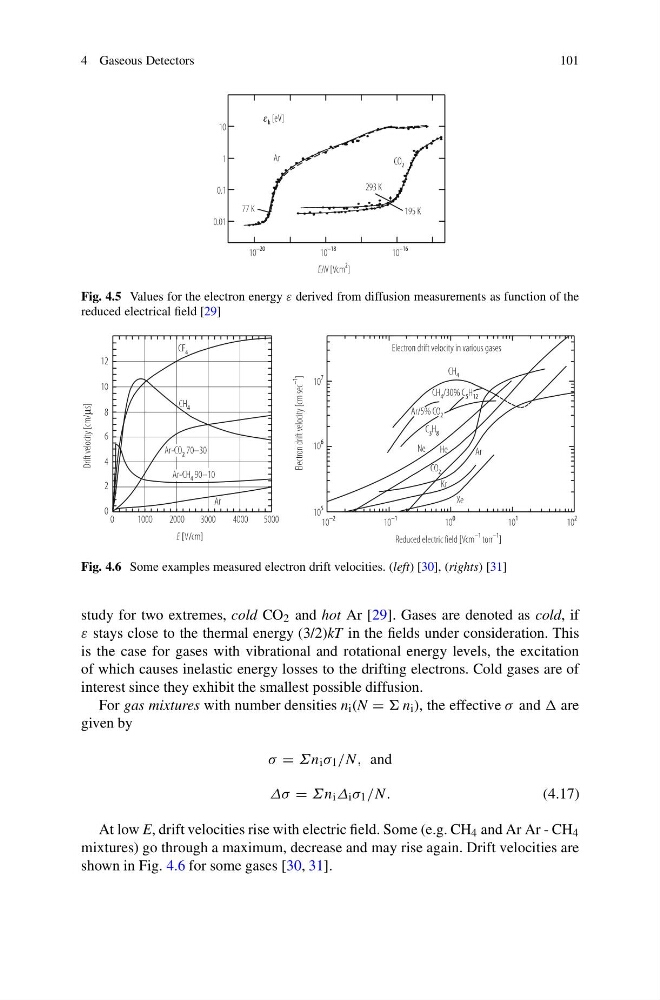
Fig. 4.5 Values for the electron energy ε derived from diffusion measurements as function of the
reduced electrical field [29]
Fig. 4.6 Some examples measured electron drift velocities. (left) [30], (rights) [31]
study for two extremes, cold CO 2 and hot Ar [29]. Gases are denoted as cold, if
ε stays close to the thermal energy (3/2)kT in the fields under consideration. This
is the case for gases with vibrational and rotational energy levels, the excitation
of which causes inelastic energy losses to the drifting electrons. Cold gases are of
interest since they exhibit the smallest possible diffusion.
For gas mixtures with number densities n i (N = n i ), the effective σ and are
given by
σ = Σn i σ 1 /N, and
Δσ = Σn i Δ i σ 1 /N.
(4.17)
At low E, drift velocities rise with electric field. Some (e.g. CH 4 and Ar Ar - CH 4
mixtures) go through a maximum, decrease and may rise again. Drift velocities are
shown in Fig. 4.6 for some gases [30, 31].
101
Fig. 4.5 Values for the electron energy ε derived from diffusion measurements as function of the
reduced electrical field [29]
Fig. 4.6 Some examples measured electron drift velocities. (left) [30], (rights) [31]
study for two extremes, cold CO 2 and hot Ar [29]. Gases are denoted as cold, if
ε stays close to the thermal energy (3/2)kT in the fields under consideration. This
is the case for gases with vibrational and rotational energy levels, the excitation
of which causes inelastic energy losses to the drifting electrons. Cold gases are of
interest since they exhibit the smallest possible diffusion.
For gas mixtures with number densities n i (N = n i ), the effective σ and are
given by
σ = Σn i σ 1 /N, and
Δσ = Σn i Δ i σ 1 /N.
(4.17)
At low E, drift velocities rise with electric field. Some (e.g. CH 4 and Ar Ar - CH 4
mixtures) go through a maximum, decrease and may rise again. Drift velocities are
shown in Fig. 4.6 for some gases [30, 31].