

100
H. J. Hilke and W. Riegler
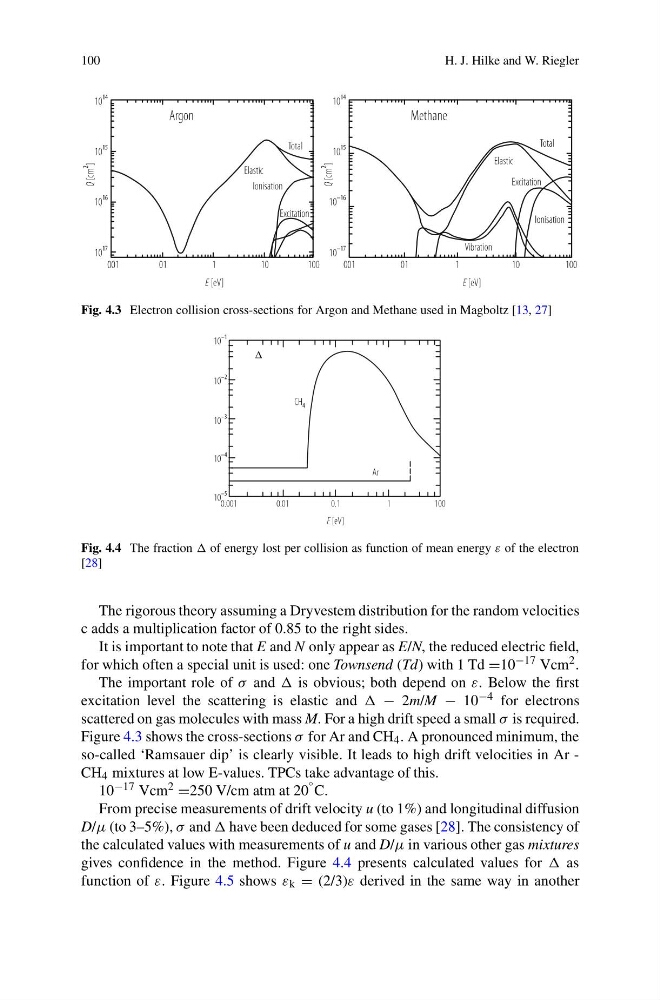
Fig. 4.3 Electron collision cross-sections for Argon and Methane used in Magboltz [13, 27]
Fig. 4.4 The fraction of energy lost per collision as function of mean energy ε of the electron
[28]
The rigorous theory assuming a Dryvestem distribution for the random velocities
c adds a multiplication factor of 0.85 to the right sides.
It is important to note that E and N only appear as E/N, the reduced electric field,
for which often a special unit is used: one Townsend (Td) with 1 Td =10 −17 Vcm 2 .
The important role of σ and is obvious; both depend on ε. Below the first
excitation level the scattering is elastic and − 2m/M − 10 −4 for electrons
scattered on gas molecules with mass M. For a high drift speed a small σ is required.
Figure 4.3 shows the cross-sections σ for Ar and CH 4 . A pronounced minimum, the
so-called ‘Ramsauer dip’ is clearly visible. It leads to high drift velocities in Ar -
CH 4 mixtures at low E-values. TPCs take advantage of this.
10 −17 Vcm 2 =250 V/cm atm at 20
◦ C.
From precise measurements of drift velocity u (to 1%) and longitudinal diffusion
D/μ (to 3–5%), σ and have been deduced for some gases [28]. The consistency of
the calculated values with measurements of u and D/μ in various other gas mixtures
gives confidence in the method. Figure 4.4 presents calculated values for as
function of ε. Figure 4.5 shows ε k = (2/3)ε derived in the same way in another
H. J. Hilke and W. Riegler
Fig. 4.3 Electron collision cross-sections for Argon and Methane used in Magboltz [13, 27]
Fig. 4.4 The fraction of energy lost per collision as function of mean energy ε of the electron
[28]
The rigorous theory assuming a Dryvestem distribution for the random velocities
c adds a multiplication factor of 0.85 to the right sides.
It is important to note that E and N only appear as E/N, the reduced electric field,
for which often a special unit is used: one Townsend (Td) with 1 Td =10 −17 Vcm 2 .
The important role of σ and is obvious; both depend on ε. Below the first
excitation level the scattering is elastic and − 2m/M − 10 −4 for electrons
scattered on gas molecules with mass M. For a high drift speed a small σ is required.
Figure 4.3 shows the cross-sections σ for Ar and CH 4 . A pronounced minimum, the
so-called ‘Ramsauer dip’ is clearly visible. It leads to high drift velocities in Ar -
CH 4 mixtures at low E-values. TPCs take advantage of this.
10 −17 Vcm 2 =250 V/cm atm at 20
◦ C.
From precise measurements of drift velocity u (to 1%) and longitudinal diffusion
D/μ (to 3–5%), σ and have been deduced for some gases [28]. The consistency of
the calculated values with measurements of u and D/μ in various other gas mixtures
gives confidence in the method. Figure 4.4 presents calculated values for as
function of ε. Figure 4.5 shows ε k = (2/3)ε derived in the same way in another