

4 Gaseous Detectors
105
4.2.2.2 Diffusion
Due to the random nature of the collisions, the individual drift velocity of an electron
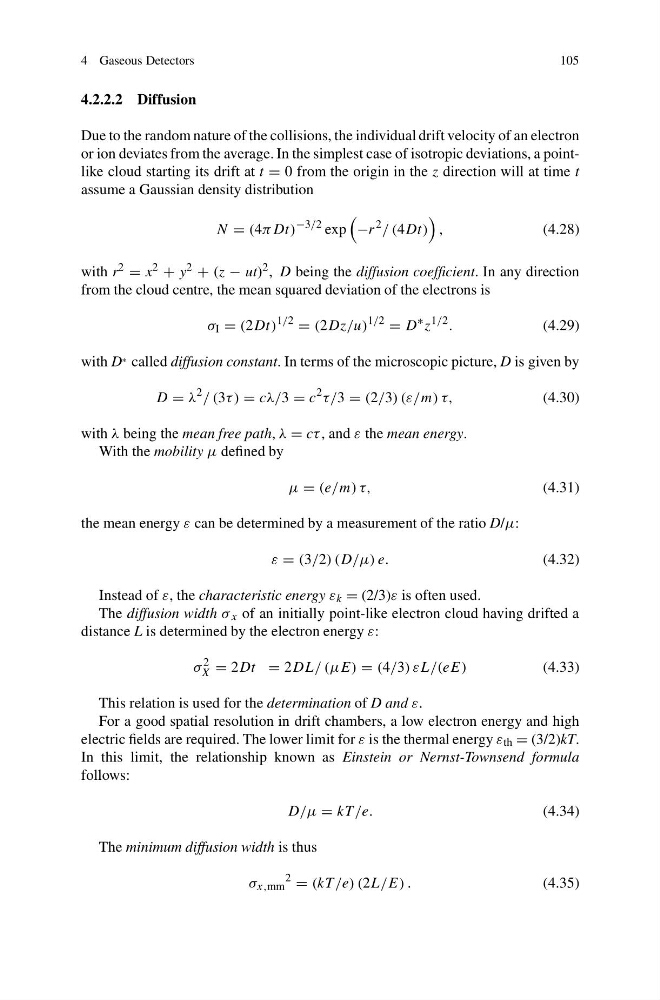
or ion deviates from the average. In the simplest case of isotropic deviations, a pointlike cloud starting its drift at t = 0 from the origin in the z direction will at time t
assume a Gaussian density distribution
N = (4πDt)
−3/2 exp
−r
2 / (4Dt)
,
(4.28)
with r 2 = x 2 + y 2 + (z − ut) 2 , D being the diffusion coefficient. In any direction
from the cloud centre, the mean squared deviation of the electrons is
σ I = (2Dt)
1/2
= (2Dz/u)
1/2
= D
∗ z
1/2 .
(4.29)
with D ∗ called diffusion constant. In terms of the microscopic picture, D is given by
D = λ
2 / (3τ ) = cλ/3 = c
2 τ/3 = (2/3) (ε/m) τ,
(4.30)
with λ being the mean free path, λ = cτ , and ε the mean energy.
With the mobility μ defined by
μ = (e/m) τ,
(4.31)
the mean energy ε can be determined by a measurement of the ratio D/μ:
ε = (3/2) (D/μ) e.
(4.32)
Instead of ε, the characteristic energy ε k = (2/3)ε is often used.
The diffusion width σ x of an initially point-like electron cloud having drifted a
distance L is determined by the electron energy ε:
σ
2
X = 2Dt = 2DL/ (μE) = (4/3) εL/(eE)
(4.33)
This relation is used for the determination of D and ε.
For a good spatial resolution in drift chambers, a low electron energy and high
electric fields are required. The lower limit for ε is the thermal energy ε th = (3/2)kT.
In this limit, the relationship known as Einstein or Nernst-Townsend formula
follows:
D/μ = kT /e.
(4.34)
The minimum diffusion width is thus
σ x,mm
2
= (kT /e) (2L/E) .
(4.35)
105
4.2.2.2 Diffusion
Due to the random nature of the collisions, the individual drift velocity of an electron
or ion deviates from the average. In the simplest case of isotropic deviations, a pointlike cloud starting its drift at t = 0 from the origin in the z direction will at time t
assume a Gaussian density distribution
N = (4πDt)
−3/2 exp
−r
2 / (4Dt)
,
(4.28)
with r 2 = x 2 + y 2 + (z − ut) 2 , D being the diffusion coefficient. In any direction
from the cloud centre, the mean squared deviation of the electrons is
σ I = (2Dt)
1/2
= (2Dz/u)
1/2
= D
∗ z
1/2 .
(4.29)
with D ∗ called diffusion constant. In terms of the microscopic picture, D is given by
D = λ
2 / (3τ ) = cλ/3 = c
2 τ/3 = (2/3) (ε/m) τ,
(4.30)
with λ being the mean free path, λ = cτ , and ε the mean energy.
With the mobility μ defined by
μ = (e/m) τ,
(4.31)
the mean energy ε can be determined by a measurement of the ratio D/μ:
ε = (3/2) (D/μ) e.
(4.32)
Instead of ε, the characteristic energy ε k = (2/3)ε is often used.
The diffusion width σ x of an initially point-like electron cloud having drifted a
distance L is determined by the electron energy ε:
σ
2
X = 2Dt = 2DL/ (μE) = (4/3) εL/(eE)
(4.33)
This relation is used for the determination of D and ε.
For a good spatial resolution in drift chambers, a low electron energy and high
electric fields are required. The lower limit for ε is the thermal energy ε th = (3/2)kT.
In this limit, the relationship known as Einstein or Nernst-Townsend formula
follows:
D/μ = kT /e.
(4.34)
The minimum diffusion width is thus
σ x,mm
2
= (kT /e) (2L/E) .
(4.35)