

3 Non-linear Dynamics in Accelerators
87
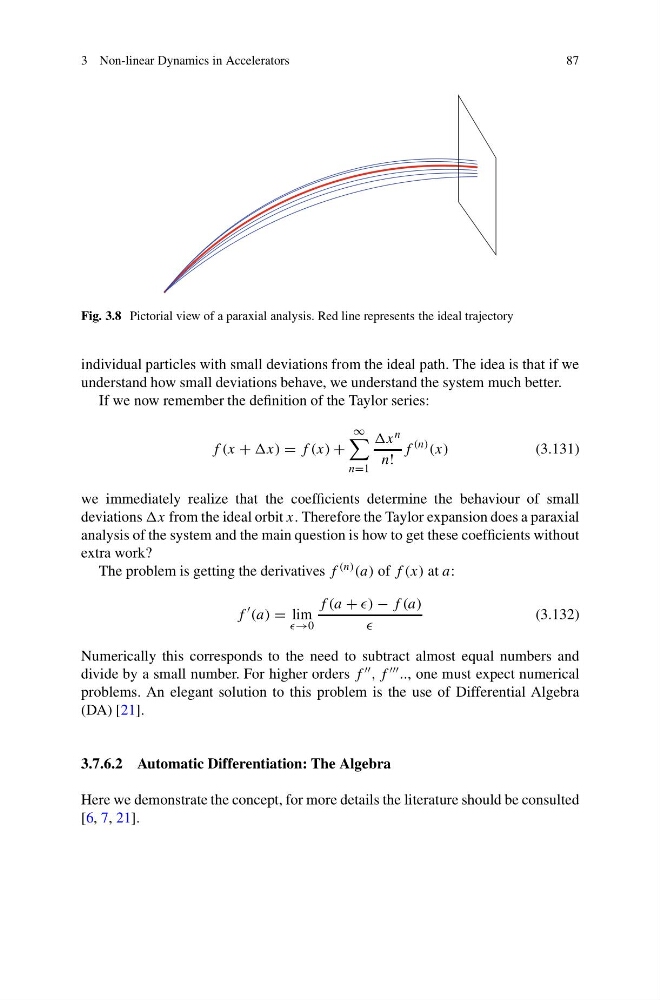
Fig. 3.8 Pictorial view of a paraxial analysis. Red line represents the ideal trajectory
individual particles with small deviations from the ideal path. The idea is that if we
understand how small deviations behave, we understand the system much better.
If we now remember the definition of the Taylor series:
f (x + x) = f (x) +
∞
n=1
n
n!
f
(n) (x)
(3.131)
we immediately realize that the coefficients determine the behaviour of small
deviations x from the ideal orbit x. Therefore the Taylor expansion does a paraxial
analysis of the system and the main question is how to get these coefficients without
extra work?
The problem is getting the derivatives f (n) (a) of f (x) at a:
f
(a) = lim
f (a + − f (a)
(3.132)
Numerically this corresponds to the need to subtract almost equal numbers and
divide by a small number. For higher orders f , f .., one must expect numerical
problems. An elegant solution to this problem is the use of Differential Algebra
(DA) [21].
3.7.6.2 Automatic Differentiation: The Algebra
Here we demonstrate the concept, for more details the literature should be consulted
[6, 7, 21].
87
Fig. 3.8 Pictorial view of a paraxial analysis. Red line represents the ideal trajectory
individual particles with small deviations from the ideal path. The idea is that if we
understand how small deviations behave, we understand the system much better.
If we now remember the definition of the Taylor series:
f (x + x) = f (x) +
∞
n=1
n
n!
f
(n) (x)
(3.131)
we immediately realize that the coefficients determine the behaviour of small
deviations x from the ideal orbit x. Therefore the Taylor expansion does a paraxial
analysis of the system and the main question is how to get these coefficients without
extra work?
The problem is getting the derivatives f (n) (a) of f (x) at a:
f
(a) = lim
f (a + − f (a)
(3.132)
Numerically this corresponds to the need to subtract almost equal numbers and
divide by a small number. For higher orders f , f .., one must expect numerical
problems. An elegant solution to this problem is the use of Differential Algebra
(DA) [21].
3.7.6.2 Automatic Differentiation: The Algebra
Here we demonstrate the concept, for more details the literature should be consulted
[6, 7, 21].