

88
W. Herr and E. Forest
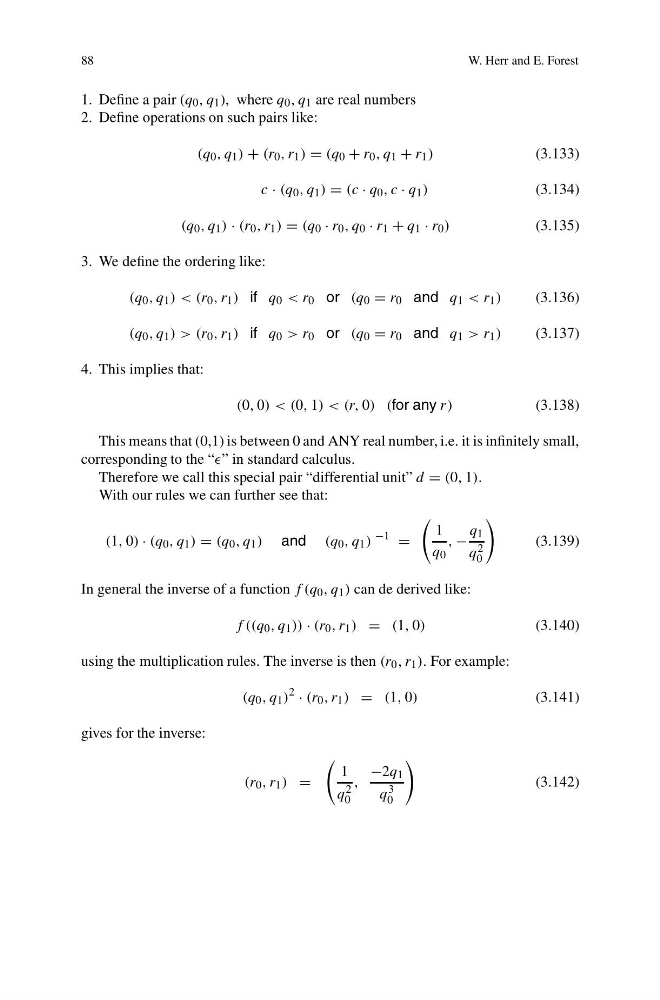
1. Define a pair (q 0 , q 1 ), where q 0 , q 1 are real numbers
2. Define operations on such pairs like:
(q 0 , q 1 ) + (r 0 , r 1 ) = (q 0 + r 0 , q 1 + r 1 )
(3.133)
c · (q 0 , q 1 ) = (c · q 0 , c · q 1 )
(3.134)
(q 0 , q 1 ) · (r 0 , r 1 ) = (q 0 · r 0 , q 0 · r 1 + q 1 · r 0 )
(3.135)
3. We define the ordering like:
(q 0 , q 1 ) < (r 0 , r 1 ) if q 0 < r 0 or (q 0 = r 0 and q 1 < r 1 )
(3.136)
(q 0 , q 1 ) > (r 0 , r 1 ) if q 0 > r 0 or (q 0 = r 0 and q 1 > r 1 )
(3.137)
4. This implies that:
(0, 0) < (0, 1) < (r, 0) (for any r)
(3.138)
This means that (0,1) is between 0 and ANY real number, i.e. it is infinitely small,
corresponding to the “” in standard calculus.
Therefore we call this special pair “differential unit” d = (0, 1).
With our rules we can further see that:
(1, 0) · (q 0 , q 1 ) = (q 0 , q 1 ) and (q 0 , q 1 )
−1
=
1
q 0
, −
q 1
q 2
0
(3.139)
In general the inverse of a function f (q 0 , q 1 ) can de derived like:
f ((q 0 , q 1 )) · (r 0 , r 1 ) = (1, 0)
(3.140)
using the multiplication rules. The inverse is then (r 0 , r 1 ). For example:
(q 0 , q 1 )
2
· (r 0 , r 1 ) = (1, 0)
(3.141)
gives for the inverse:
(r 0 , r 1 ) =
1
q 2
0
,
−2q 1
q
3
0
(3.142)
W. Herr and E. Forest
1. Define a pair (q 0 , q 1 ), where q 0 , q 1 are real numbers
2. Define operations on such pairs like:
(q 0 , q 1 ) + (r 0 , r 1 ) = (q 0 + r 0 , q 1 + r 1 )
(3.133)
c · (q 0 , q 1 ) = (c · q 0 , c · q 1 )
(3.134)
(q 0 , q 1 ) · (r 0 , r 1 ) = (q 0 · r 0 , q 0 · r 1 + q 1 · r 0 )
(3.135)
3. We define the ordering like:
(q 0 , q 1 ) < (r 0 , r 1 ) if q 0 < r 0 or (q 0 = r 0 and q 1 < r 1 )
(3.136)
(q 0 , q 1 ) > (r 0 , r 1 ) if q 0 > r 0 or (q 0 = r 0 and q 1 > r 1 )
(3.137)
4. This implies that:
(0, 0) < (0, 1) < (r, 0) (for any r)
(3.138)
This means that (0,1) is between 0 and ANY real number, i.e. it is infinitely small,
corresponding to the “” in standard calculus.
Therefore we call this special pair “differential unit” d = (0, 1).
With our rules we can further see that:
(1, 0) · (q 0 , q 1 ) = (q 0 , q 1 ) and (q 0 , q 1 )
−1
=
1
q 0
, −
q 1
q 2
0
(3.139)
In general the inverse of a function f (q 0 , q 1 ) can de derived like:
f ((q 0 , q 1 )) · (r 0 , r 1 ) = (1, 0)
(3.140)
using the multiplication rules. The inverse is then (r 0 , r 1 ). For example:
(q 0 , q 1 )
2
· (r 0 , r 1 ) = (1, 0)
(3.141)
gives for the inverse:
(r 0 , r 1 ) =
1
q 2
0
,
−2q 1
q
3
0
(3.142)