

82
W. Herr and E. Forest
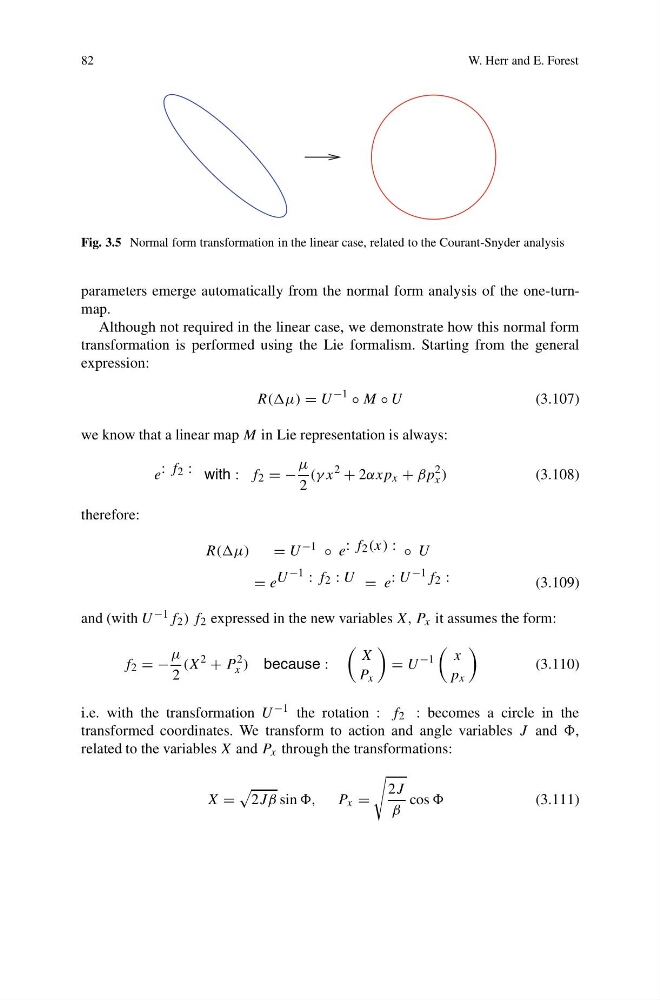
Fig. 3.5 Normal form transformation in the linear case, related to the Courant-Snyder analysis
parameters emerge automatically from the normal form analysis of the one-turnmap.
Although not required in the linear case, we demonstrate how this normal form
transformation is performed using the Lie formalism. Starting from the general
expression:
R((μ) = U
−1
◦ M ◦ U
(3.107)
we know that a linear map M in Lie representation is always:
e : f 2 : with : f 2 = −
μ
2
(γ x
2
+ 2αxp x + βp
2
x )
(3.108)
therefore:
R((μ)
= U −1 ◦ e : f 2 (x) : ◦ U
= e U −1 : f 2 : U = e : U −1 f 2 :
(3.109)
and (with U −1 f 2 ) f 2 expressed in the new variables X, P x it assumes the form:
f 2 = −
μ
2
(X
2
+ P
2
x ) because :
X
P x
= U
−1
x
p x
(3.110)
i.e. with the transformation U −1 the rotation : f 2 : becomes a circle in the
transformed coordinates. We transform to action and angle variables J and
related to the variables X and P x through the transformations:
X =
2Jβ sin , P x =
2J
β
cos
(3.111)
W. Herr and E. Forest
Fig. 3.5 Normal form transformation in the linear case, related to the Courant-Snyder analysis
parameters emerge automatically from the normal form analysis of the one-turnmap.
Although not required in the linear case, we demonstrate how this normal form
transformation is performed using the Lie formalism. Starting from the general
expression:
R((μ) = U
−1
◦ M ◦ U
(3.107)
we know that a linear map M in Lie representation is always:
e : f 2 : with : f 2 = −
μ
2
(γ x
2
+ 2αxp x + βp
2
x )
(3.108)
therefore:
R((μ)
= U −1 ◦ e : f 2 (x) : ◦ U
= e U −1 : f 2 : U = e : U −1 f 2 :
(3.109)
and (with U −1 f 2 ) f 2 expressed in the new variables X, P x it assumes the form:
f 2 = −
μ
2
(X
2
+ P
2
x ) because :
X
P x
= U
−1
x
p x
(3.110)
i.e. with the transformation U −1 the rotation : f 2 : becomes a circle in the
transformed coordinates. We transform to action and angle variables J and
related to the variables X and P x through the transformations:
X =
2Jβ sin , P x =
2J
β
cos
(3.111)