

3 Non-linear Dynamics in Accelerators
83
With this transformation we get a simple representation for the linear transfer
map f 2 :
f 2 = −μJ and : R((μ) = e : −μJ :
(3.112)
3.7.5.2 Normal Form Transformation: Non-linear Case
In the more general, non-linear case the transformation is more complicated and
one must expect that the rotation angle becomes amplitude dependent (see e.g. [6]).
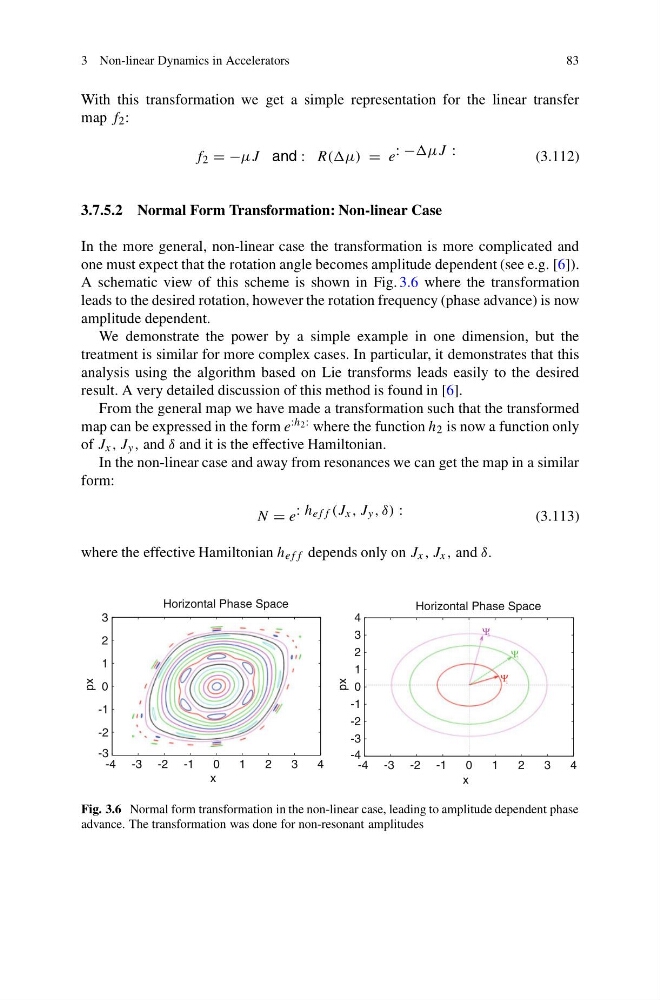
A schematic view of this scheme is shown in Fig. 3.6 where the transformation
leads to the desired rotation, however the rotation frequency (phase advance) is now
amplitude dependent.
We demonstrate the power by a simple example in one dimension, but the
treatment is similar for more complex cases. In particular, it demonstrates that this
analysis using the algorithm based on Lie transforms leads easily to the desired
result. A very detailed discussion of this method is found in [6].
From the general map we have made a transformation such that the transformed
map can be expressed in the form e :h 2 : where the function h 2 is now a function only
of J x , J y , and δ and it is the effective Hamiltonian.
In the non-linear case and away from resonances we can get the map in a similar
form:
N = e : h eff (J x , J y , δ) :
(3.113)
where the effective Hamiltonian h eff depends only on J x , J x , and δ.
-3
-2
-1
0
1
2
3
-4 -3 -2 -1
0
1
2
3
4
px
x
Horizontal Phase Space
-4
-3
-2
-1
0
1
2
3
4
-4 -3 -2 -1
0
1
2
3
4
px
x
Horizontal Phase Space
Ψ 1
Ψ 2
Ψ 3
Fig. 3.6 Normal form transformation in the non-linear case, leading to amplitude dependent phase
advance. The transformation was done for non-resonant amplitudes
83
With this transformation we get a simple representation for the linear transfer
map f 2 :
f 2 = −μJ and : R((μ) = e : −μJ :
(3.112)
3.7.5.2 Normal Form Transformation: Non-linear Case
In the more general, non-linear case the transformation is more complicated and
one must expect that the rotation angle becomes amplitude dependent (see e.g. [6]).
A schematic view of this scheme is shown in Fig. 3.6 where the transformation
leads to the desired rotation, however the rotation frequency (phase advance) is now
amplitude dependent.
We demonstrate the power by a simple example in one dimension, but the
treatment is similar for more complex cases. In particular, it demonstrates that this
analysis using the algorithm based on Lie transforms leads easily to the desired
result. A very detailed discussion of this method is found in [6].
From the general map we have made a transformation such that the transformed
map can be expressed in the form e :h 2 : where the function h 2 is now a function only
of J x , J y , and δ and it is the effective Hamiltonian.
In the non-linear case and away from resonances we can get the map in a similar
form:
N = e : h eff (J x , J y , δ) :
(3.113)
where the effective Hamiltonian h eff depends only on J x , J x , and δ.
-3
-2
-1
0
1
2
3
-4 -3 -2 -1
0
1
2
3
4
px
x
Horizontal Phase Space
-4
-3
-2
-1
0
1
2
3
4
-4 -3 -2 -1
0
1
2
3
4
px
x
Horizontal Phase Space
Ψ 1
Ψ 2
Ψ 3
Fig. 3.6 Normal form transformation in the non-linear case, leading to amplitude dependent phase
advance. The transformation was done for non-resonant amplitudes