

3 Non-linear Dynamics in Accelerators
81
presence of the non-linear element. The main features we can observe in Fig. 3.4 are
that particles can:
• Move on closed curves
• Lie on islands, i.e. jump from one island to the next from turn to turn
• Move on chaotic trajectories
The introduction of these techniques by Poincare mark a paradigm shift from
the old classical treatment to a more modern approach. The question of long
term stability of a dynamic system is not answered by getting the solution to the
differential equation of motion, but by the determination of the properties of the
surface where the motion is mapped out. Independent how this surface of section
is obtained, i.e. by analytical or numerical methods, its analysis is the key to
understand the stability.
3.7.5 Analysis Techniques: Normal Forms
The idea behind this technique is that maps can be transformed into Normal Forms.
This tool can be used to:
• Study invariants of the motion and the effective Hamiltonian
• Extract non-linear tune shifts (detuning)
• Perform resonance analysis
In the following we demonstrate the use of normal forms away from resonances.
The treatment of the beam dynamics close to resonances is beyond the scope of this
review and can be found in the literature (see e.g. [6, 7]).
3.7.5.1 Normal Form Transformation: Linear Case
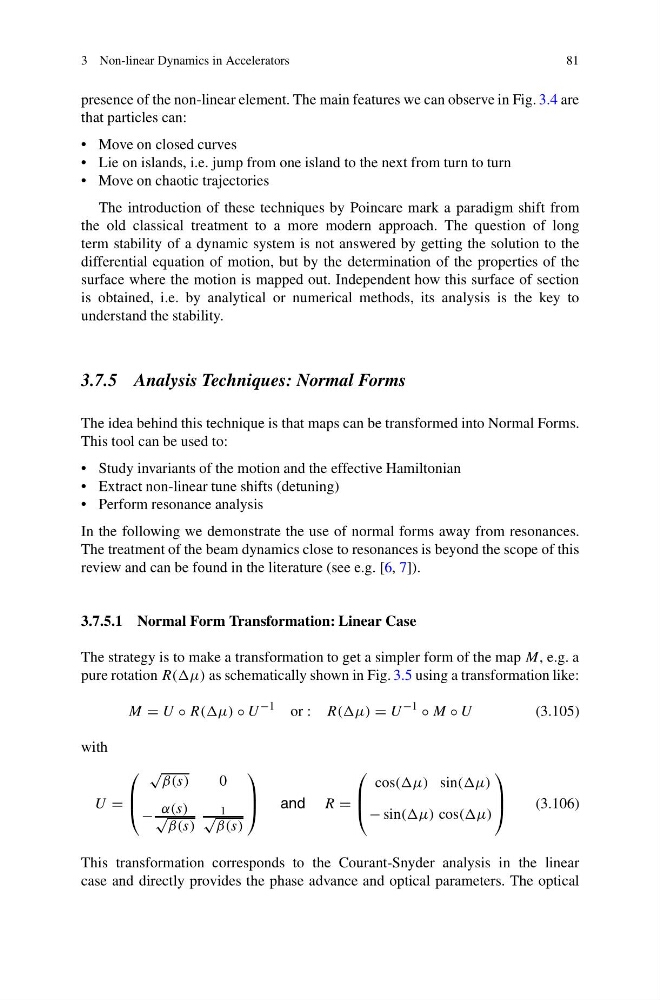
The strategy is to make a transformation to get a simpler form of the map M, e.g. a
pure rotation R((μ) as schematically shown in Fig. 3.5 using a transformation like:
M = U ◦ R((μ) ◦ U
−1 or : R((μ) = U
−1
◦ M ◦ U
(3.105)
with
U =
⎛
⎜
⎝
√
β(s)
0
− α(s)
√
β(s)
1
√
β(s)
⎞
⎟
⎠ and R =
⎛
⎜
⎝
cos((μ) sin((μ)
− sin((μ) cos((μ)
⎞
⎟
⎠
(3.106)
This transformation corresponds to the Courant-Snyder analysis in the linear
case and directly provides the phase advance and optical parameters. The optical
81
presence of the non-linear element. The main features we can observe in Fig. 3.4 are
that particles can:
• Move on closed curves
• Lie on islands, i.e. jump from one island to the next from turn to turn
• Move on chaotic trajectories
The introduction of these techniques by Poincare mark a paradigm shift from
the old classical treatment to a more modern approach. The question of long
term stability of a dynamic system is not answered by getting the solution to the
differential equation of motion, but by the determination of the properties of the
surface where the motion is mapped out. Independent how this surface of section
is obtained, i.e. by analytical or numerical methods, its analysis is the key to
understand the stability.
3.7.5 Analysis Techniques: Normal Forms
The idea behind this technique is that maps can be transformed into Normal Forms.
This tool can be used to:
• Study invariants of the motion and the effective Hamiltonian
• Extract non-linear tune shifts (detuning)
• Perform resonance analysis
In the following we demonstrate the use of normal forms away from resonances.
The treatment of the beam dynamics close to resonances is beyond the scope of this
review and can be found in the literature (see e.g. [6, 7]).
3.7.5.1 Normal Form Transformation: Linear Case
The strategy is to make a transformation to get a simpler form of the map M, e.g. a
pure rotation R((μ) as schematically shown in Fig. 3.5 using a transformation like:
M = U ◦ R((μ) ◦ U
−1 or : R((μ) = U
−1
◦ M ◦ U
(3.105)
with
U =
⎛
⎜
⎝
√
β(s)
0
− α(s)
√
β(s)
1
√
β(s)
⎞
⎟
⎠ and R =
⎛
⎜
⎝
cos((μ) sin((μ)
− sin((μ) cos((μ)
⎞
⎟
⎠
(3.106)
This transformation corresponds to the Courant-Snyder analysis in the linear
case and directly provides the phase advance and optical parameters. The optical