

3 Non-linear Dynamics in Accelerators
71
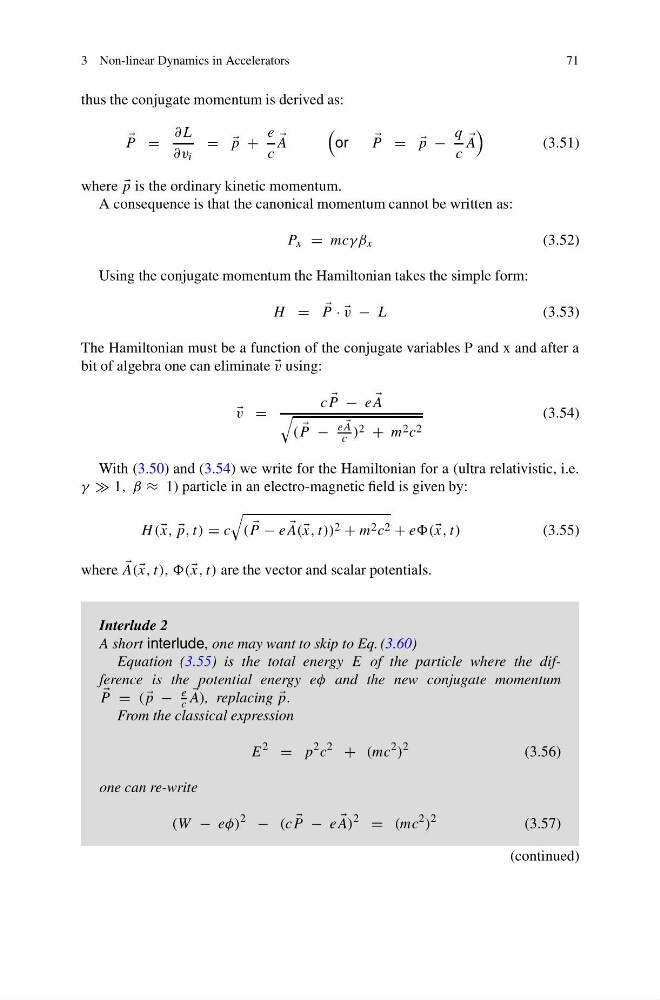
thus the conjugate momentum is derived as:
P =
∂L
∂v i
= =
p +
e
c
A
or
P = =
p −
q
c
A
(3.51)
where
p is the ordinary kinetic momentum.
A consequence is that the canonical momentum cannot be written as:
P x = mcγβ x
(3.52)
Using the conjugate momentum the Hamiltonian takes the simple form:
H =
P · ·
v − L
(3.53)
The Hamiltonian must be a function of the conjugate variables P and x and after a
bit of algebra one can eliminate
v using:
v =
c
P − e
A
(
P −
e
A
c ) 2 + m 2 c 2
(3.54)
With (3.50) and (3.54) we write for the Hamiltonian for a (ultra relativistic, i.e.
γ 1, β ≈ 1) particle in an electro-magnetic field is given by:
H ( x,
p, t) = c
(
P − e
A( x, t)) 2 + m 2 c 2 + ee( x, t)
(3.55)
where
A( x, t), x, t) are the vector and scalar potentials.
Interlude 2
A short interlude, one may want to skip to Eq. (3.60)
Equation (3.55) is the total energy E of the particle where the difference is the potential energy eφ and the new conjugate momentum
P = (
p −
e
c
A), replacing
p.
From the classical expression
E
2
= p
2 c
2
+ (mc
2 )
2
(3.56)
one can re-write
(W − eφ)
2
− (c
P − e
A)
2
= (mc
2 )
2
(3.57)
(continued)
71
thus the conjugate momentum is derived as:
P =
∂L
∂v i
= =
p +
e
c
A
or
P = =
p −
q
c
A
(3.51)
where
p is the ordinary kinetic momentum.
A consequence is that the canonical momentum cannot be written as:
P x = mcγβ x
(3.52)
Using the conjugate momentum the Hamiltonian takes the simple form:
H =
P · ·
v − L
(3.53)
The Hamiltonian must be a function of the conjugate variables P and x and after a
bit of algebra one can eliminate
v using:
v =
c
P − e
A
(
P −
e
A
c ) 2 + m 2 c 2
(3.54)
With (3.50) and (3.54) we write for the Hamiltonian for a (ultra relativistic, i.e.
γ 1, β ≈ 1) particle in an electro-magnetic field is given by:
H ( x,
p, t) = c
(
P − e
A( x, t)) 2 + m 2 c 2 + ee( x, t)
(3.55)
where
A( x, t), x, t) are the vector and scalar potentials.
Interlude 2
A short interlude, one may want to skip to Eq. (3.60)
Equation (3.55) is the total energy E of the particle where the difference is the potential energy eφ and the new conjugate momentum
P = (
p −
e
c
A), replacing
p.
From the classical expression
E
2
= p
2 c
2
+ (mc
2 )
2
(3.56)
one can re-write
(W − eφ)
2
− (c
P − e
A)
2
= (mc
2 )
2
(3.57)
(continued)