

72
W. Herr and E. Forest
The expression (mc 2 ) 2 is the invariant mass [13], i.e.
p μ p
μ
= (mc)
2
(3.58)
with the 4-vector for the momentum [13]:
p
μ
= (
E
c
,
p) =
1
c
(W − eφ),
P − (
e
c
A)
(3.59)
The changes are a consequence using 4-vectors in the presence of electromagnetic fields (potentials).
An interesting consequence of (3.51) is that the momentum is linked to the fields
(
A) and the angle x cannot easily be derived from the total momentum and the
conjugate momentum. That is using (x, x ) as coordinate are strictly speaking not
valid in the presence of electromagnetic fields.
In this context using (x, x ) or (x, p x ) is not equivalent. A general, strong
statement that (x, x ) is used in accelerator physics is at best bizarre.
3.7.3 Hamiltonian Used for Accelerator Physics
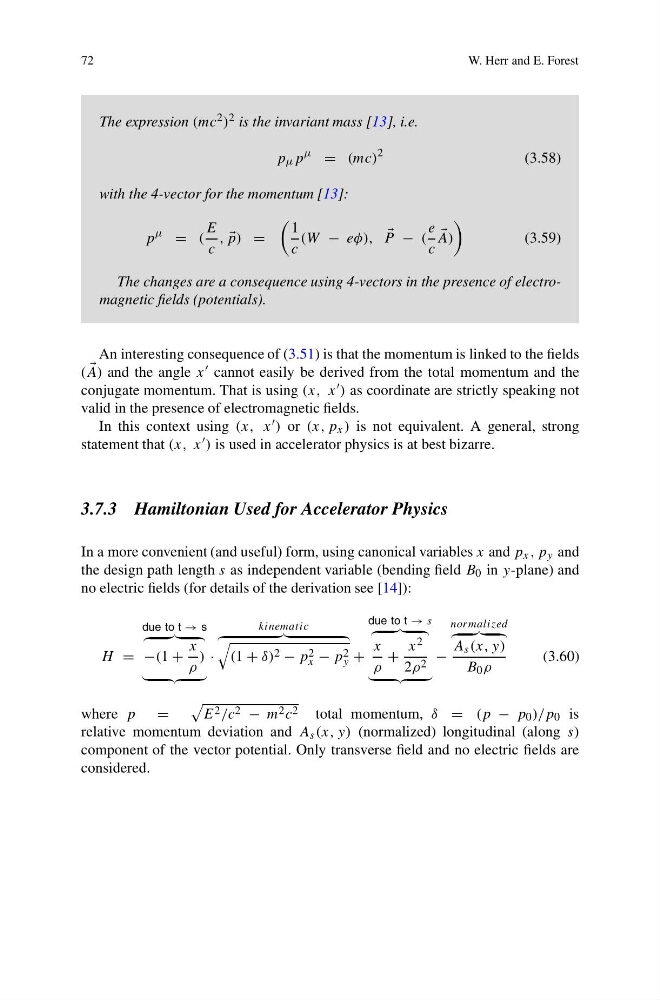
In a more convenient (and useful) form, using canonical variables x and p x , p y and
the design path length s as independent variable (bending field B 0 in y-plane) and
no electric fields (for details of the derivation see [14]):
H =
due to t → s
−(1 +
x
ρ
)
·
kinematic
(1 + δ) 2 − p 2
x − p 2
y +
due to t → s
x
ρ
+
x 2
2ρ 2
−
normalized
A s (x, y)
B 0 ρ
(3.60)
where p =
E 2 /c 2 − m 2 c 2 total momentum, δ = (p − p 0 )/p 0 is
relative momentum deviation and A s (x, y) (normalized) longitudinal (along s)
component of the vector potential. Only transverse field and no electric fields are
considered.
W. Herr and E. Forest
The expression (mc 2 ) 2 is the invariant mass [13], i.e.
p μ p
μ
= (mc)
2
(3.58)
with the 4-vector for the momentum [13]:
p
μ
= (
E
c
,
p) =
1
c
(W − eφ),
P − (
e
c
A)
(3.59)
The changes are a consequence using 4-vectors in the presence of electromagnetic fields (potentials).
An interesting consequence of (3.51) is that the momentum is linked to the fields
(
A) and the angle x cannot easily be derived from the total momentum and the
conjugate momentum. That is using (x, x ) as coordinate are strictly speaking not
valid in the presence of electromagnetic fields.
In this context using (x, x ) or (x, p x ) is not equivalent. A general, strong
statement that (x, x ) is used in accelerator physics is at best bizarre.
3.7.3 Hamiltonian Used for Accelerator Physics
In a more convenient (and useful) form, using canonical variables x and p x , p y and
the design path length s as independent variable (bending field B 0 in y-plane) and
no electric fields (for details of the derivation see [14]):
H =
due to t → s
−(1 +
x
ρ
)
·
kinematic
(1 + δ) 2 − p 2
x − p 2
y +
due to t → s
x
ρ
+
x 2
2ρ 2
−
normalized
A s (x, y)
B 0 ρ
(3.60)
where p =
E 2 /c 2 − m 2 c 2 total momentum, δ = (p − p 0 )/p 0 is
relative momentum deviation and A s (x, y) (normalized) longitudinal (along s)
component of the vector potential. Only transverse field and no electric fields are
considered.