

70
W. Herr and E. Forest
The coordinates q i are identical to those in the Lagrangian (3.41), whereas the
conjugate momenta p i are derived from L as:
p i =
∂L
∂ ˙
q i
.
(3.45)
3.7.2 Hamiltonian with Electro-Magnetic Fields
Readers only interested in the final result can skip Eqs. (3.46)–(3.54).
A key for the correct Hamiltonian is the relativistic treatment. An intuitive
derivation is presented here, a simpler and elegant derivation should be based on
4-vectors [13]. The action S must be a relativistic invariant and becomes (now using
coordinates x and velocities v):
S =
L( x i (t), v i (t), t ) γ · dτ.
(3.46)
since the proper time τ is Lorentz invariant, and therefore also γ · L.
The Lagrangian for a free particle is usually a function of the velocity (see
classical formula of the kinematic term), but must not depend on its position.
The only Lorentz invariant with the velocity is [13]:
U
μ U μ = c
2
(3.47)
where U is the four-velocity.
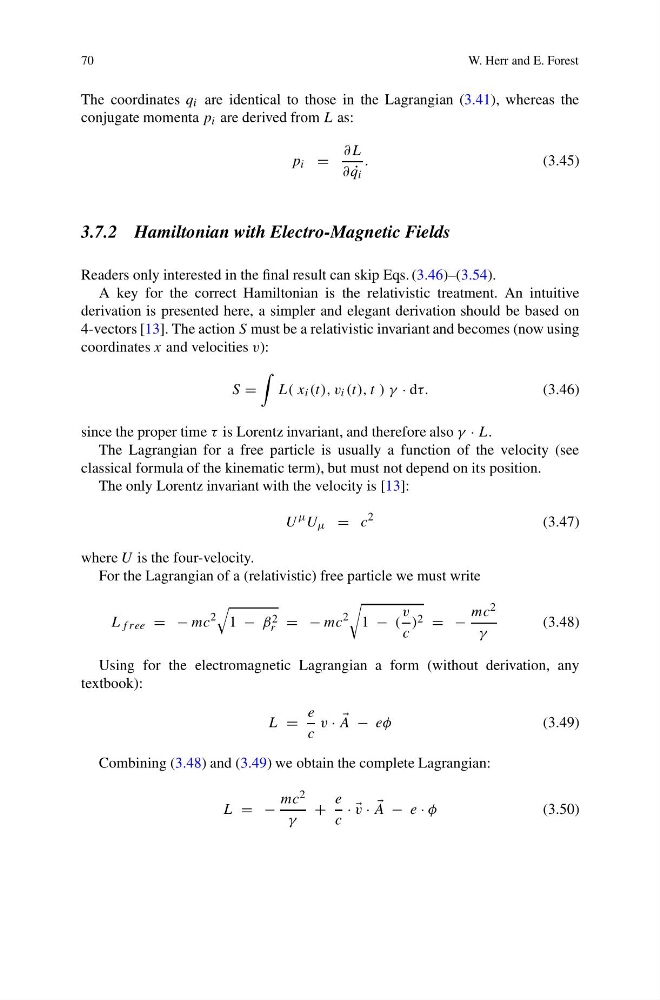
For the Lagrangian of a (relativistic) free particle we must write
L f ree = − mc
2
1 − β 2
r = − mc
2
1 − (
v
c
) 2 = −
mc 2
γ
(3.48)
Using for the electromagnetic Lagrangian a form (without derivation, any
textbook):
L =
e
c
v ·
A − eφ
(3.49)
Combining (3.48) and (3.49) we obtain the complete Lagrangian:
L = −
mc 2
γ
+
e
c
· ·
v ·
A − e · φ
(3.50)
W. Herr and E. Forest
The coordinates q i are identical to those in the Lagrangian (3.41), whereas the
conjugate momenta p i are derived from L as:
p i =
∂L
∂ ˙
q i
.
(3.45)
3.7.2 Hamiltonian with Electro-Magnetic Fields
Readers only interested in the final result can skip Eqs. (3.46)–(3.54).
A key for the correct Hamiltonian is the relativistic treatment. An intuitive
derivation is presented here, a simpler and elegant derivation should be based on
4-vectors [13]. The action S must be a relativistic invariant and becomes (now using
coordinates x and velocities v):
S =
L( x i (t), v i (t), t ) γ · dτ.
(3.46)
since the proper time τ is Lorentz invariant, and therefore also γ · L.
The Lagrangian for a free particle is usually a function of the velocity (see
classical formula of the kinematic term), but must not depend on its position.
The only Lorentz invariant with the velocity is [13]:
U
μ U μ = c
2
(3.47)
where U is the four-velocity.
For the Lagrangian of a (relativistic) free particle we must write
L f ree = − mc
2
1 − β 2
r = − mc
2
1 − (
v
c
) 2 = −
mc 2
γ
(3.48)
Using for the electromagnetic Lagrangian a form (without derivation, any
textbook):
L =
e
c
v ·
A − eφ
(3.49)
Combining (3.48) and (3.49) we obtain the complete Lagrangian:
L = −
mc 2
γ
+
e
c
· ·
v ·
A − e · φ
(3.50)