

3 Non-linear Dynamics in Accelerators
69
– With Hamiltonian it is free: The formalism is “coordinate invariant”, i.e. the
equations have the same form in every coordinate system.
– The basic equations ensure that the phase space is conserved
3.7.1 Lagrangian of Electro-Magnetic Fields
3.7.1.1 Lagrangian and Hamiltonian
It is common practice to use q for the coordinates when Hamiltonian and Lagrangian
formalisms are used. This is deplorable because q is also used for particle charge.
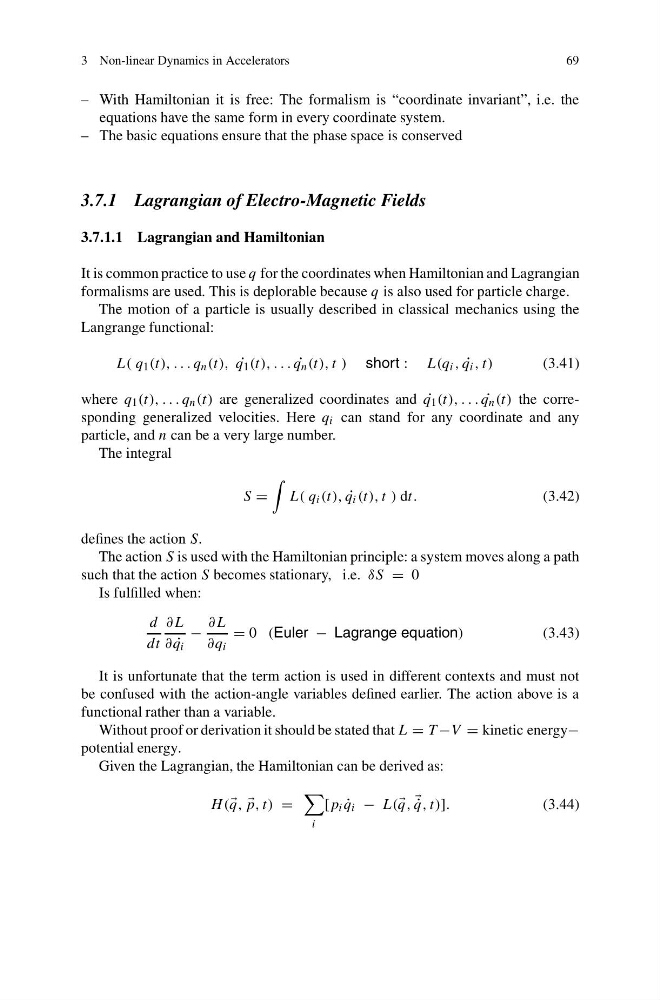
The motion of a particle is usually described in classical mechanics using the
Langrange functional:
L( q 1 (t), . . . q n (t), ˙
q 1 (t), . . . ˙
q n (t), t ) short : L(q i , ˙
q i , t)
(3.41)
where q 1 (t), . . . q n (t) are generalized coordinates and ˙
q 1 (t), . . . ˙
q n (t) the corresponding generalized velocities. Here q i can stand for any coordinate and any
particle, and n can be a very large number.
The integral
S =
L( q i (t), ˙
q i (t), t ) dt.
(3.42)
defines the action S.
The action S is used with the Hamiltonian principle: a system moves along a path
such that the action S becomes stationary, i.e. δS = 0
Is fulfilled when:
d
dt
∂L
∂ ˙
q i
−
∂L
∂q i
= 0 (Euler − Lagrange equation)
(3.43)
It is unfortunate that the term action is used in different contexts and must not
be confused with the action-angle variables defined earlier. The action above is a
functional rather than a variable.
Without proof or derivation it should be stated that L = T −V = kinetic energy−
potential energy.
Given the Lagrangian, the Hamiltonian can be derived as:
H ( q,
p, t) =
i
[p i ˙
q i − L( q, ˙
q, t)].
(3.44)
69
– With Hamiltonian it is free: The formalism is “coordinate invariant”, i.e. the
equations have the same form in every coordinate system.
– The basic equations ensure that the phase space is conserved
3.7.1 Lagrangian of Electro-Magnetic Fields
3.7.1.1 Lagrangian and Hamiltonian
It is common practice to use q for the coordinates when Hamiltonian and Lagrangian
formalisms are used. This is deplorable because q is also used for particle charge.
The motion of a particle is usually described in classical mechanics using the
Langrange functional:
L( q 1 (t), . . . q n (t), ˙
q 1 (t), . . . ˙
q n (t), t ) short : L(q i , ˙
q i , t)
(3.41)
where q 1 (t), . . . q n (t) are generalized coordinates and ˙
q 1 (t), . . . ˙
q n (t) the corresponding generalized velocities. Here q i can stand for any coordinate and any
particle, and n can be a very large number.
The integral
S =
L( q i (t), ˙
q i (t), t ) dt.
(3.42)
defines the action S.
The action S is used with the Hamiltonian principle: a system moves along a path
such that the action S becomes stationary, i.e. δS = 0
Is fulfilled when:
d
dt
∂L
∂ ˙
q i
−
∂L
∂q i
= 0 (Euler − Lagrange equation)
(3.43)
It is unfortunate that the term action is used in different contexts and must not
be confused with the action-angle variables defined earlier. The action above is a
functional rather than a variable.
Without proof or derivation it should be stated that L = T −V = kinetic energy−
potential energy.
Given the Lagrangian, the Hamiltonian can be derived as:
H ( q,
p, t) =
i
[p i ˙
q i − L( q, ˙
q, t)].
(3.44)