

11 Application of Accelerators and Storage Rings
785
energies and intensities have been performed since mid-1980s, with the special
aim of improving the situation for exotic-beam experiments. This has been done by
introducing ECR ion sources, by modifying the injection systems into the C01/C02
injector cyclotrons, and by improving performance of components for the operation
with beam powers of up to several kW in and after the CSS2 [281, 283]. In-flight
technology was used to produce exotic beams [283].
Since 2001, when a fifth cyclotron, CIME, went into operation, the Isotope
Separation On-Line (ISOL) technique was also used to produce rare isotopes [284].
The exotic isotopes, which were produced in thick targets using high power ion
beams of up to 3 kW from the CSS2 cyclotron, were transferred into a charge
breeding ECR ion source, and post-accelerated in the compact cyclotron CIME
(K = 265). Depending on the isotope, energies in the range from 1.2 to 25 MeV/u
are delivered from CIME. These beams are transferred to the existing experimental
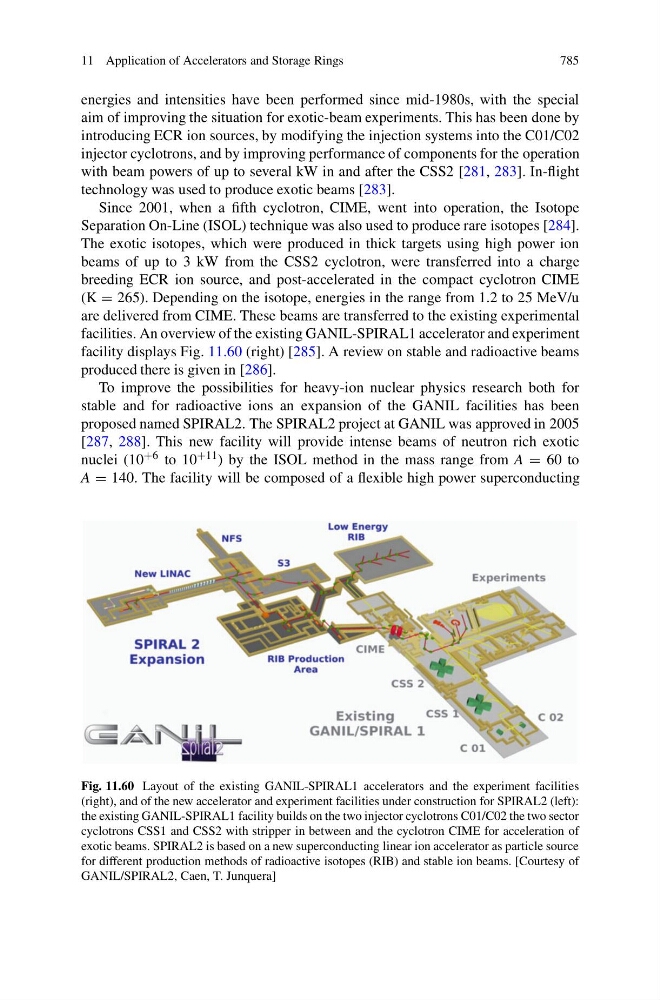
facilities. An overview of the existing GANIL-SPIRAL1 accelerator and experiment
facility displays Fig. 11.60 (right) [285]. A review on stable and radioactive beams
produced there is given in [286].
To improve the possibilities for heavy-ion nuclear physics research both for
stable and for radioactive ions an expansion of the GANIL facilities has been
proposed named SPIRAL2. The SPIRAL2 project at GANIL was approved in 2005
[287, 288]. This new facility will provide intense beams of neutron rich exotic
nuclei (10 +6 to 10 +11 ) by the ISOL method in the mass range from A = 60 to
A = 140. The facility will be composed of a flexible high power superconducting
Fig. 11.60 Layout of the existing GANIL-SPIRAL1 accelerators and the experiment facilities
(right), and of the new accelerator and experiment facilities under construction for SPIRAL2 (left):
the existing GANIL-SPIRAL1 facility builds on the two injector cyclotrons C01/C02 the two sector
cyclotrons CSS1 and CSS2 with stripper in between and the cyclotron CIME for acceleration of
exotic beams. SPIRAL2 is based on a new superconducting linear ion accelerator as particle source
for different production methods of radioactive isotopes (RIB) and stable ion beams. [Courtesy of
GANIL/SPIRAL2, Caen, T. Junquera]