

784
M. Dohlus et al.
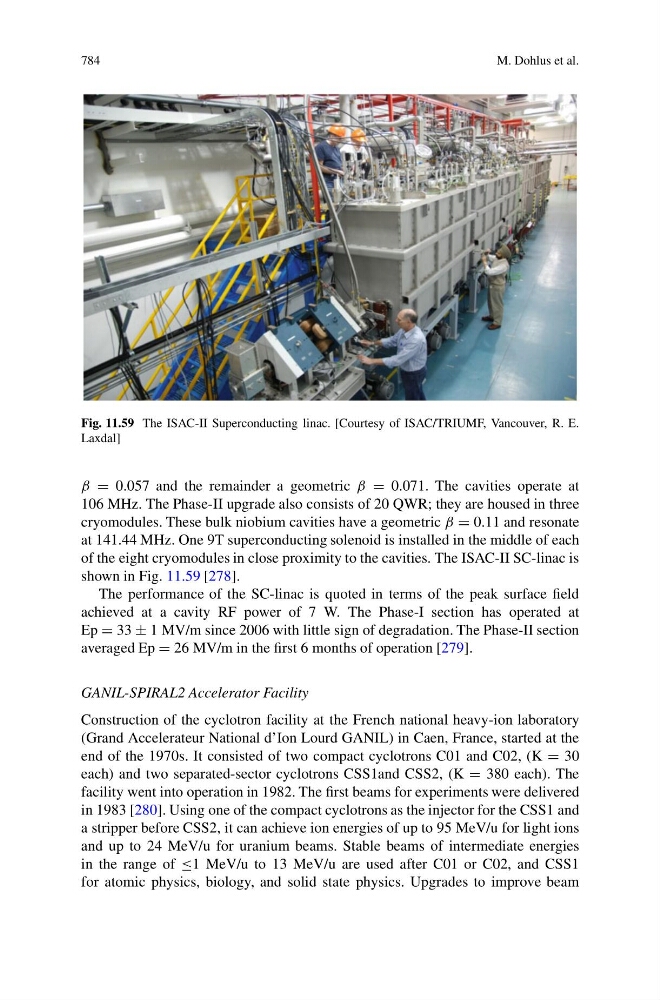
Fig. 11.59 The ISAC-II Superconducting linac. [Courtesy of ISAC/TRIUMF, Vancouver, R. E.
Laxdal]
β = 0.057 and the remainder a geometric β = 0.071. The cavities operate at
106 MHz. The Phase-II upgrade also consists of 20 QWR; they are housed in three
cryomodules. These bulk niobium cavities have a geometric β = 0.11 and resonate
at 141.44 MHz. One 9T superconducting solenoid is installed in the middle of each
of the eight cryomodules in close proximity to the cavities. The ISAC-II SC-linac is
shown in Fig. 11.59 [278].
The performance of the SC-linac is quoted in terms of the peak surface field
achieved at a cavity RF power of 7 W. The Phase-I section has operated at
Ep = 33 ± 1 MV/m since 2006 with little sign of degradation. The Phase-II section
averaged Ep = 26 MV/m in the first 6 months of operation [279].
GANIL-SPIRAL2 Accelerator Facility
Construction of the cyclotron facility at the French national heavy-ion laboratory
(Grand Accelerateur National d’Ion Lourd GANIL) in Caen, France, started at the
end of the 1970s. It consisted of two compact cyclotrons C01 and C02, (K = 30
each) and two separated-sector cyclotrons CSS1and CSS2, (K = 380 each). The
facility went into operation in 1982. The first beams for experiments were delivered
in 1983 [280]. Using one of the compact cyclotrons as the injector for the CSS1 and
a stripper before CSS2, it can achieve ion energies of up to 95 MeV/u for light ions
and up to 24 MeV/u for uranium beams. Stable beams of intermediate energies
in the range of ≤1 MeV/u to 13 MeV/u are used after C01 or C02, and CSS1
for atomic physics, biology, and solid state physics. Upgrades to improve beam