

11 Application of Accelerators and Storage Rings
783
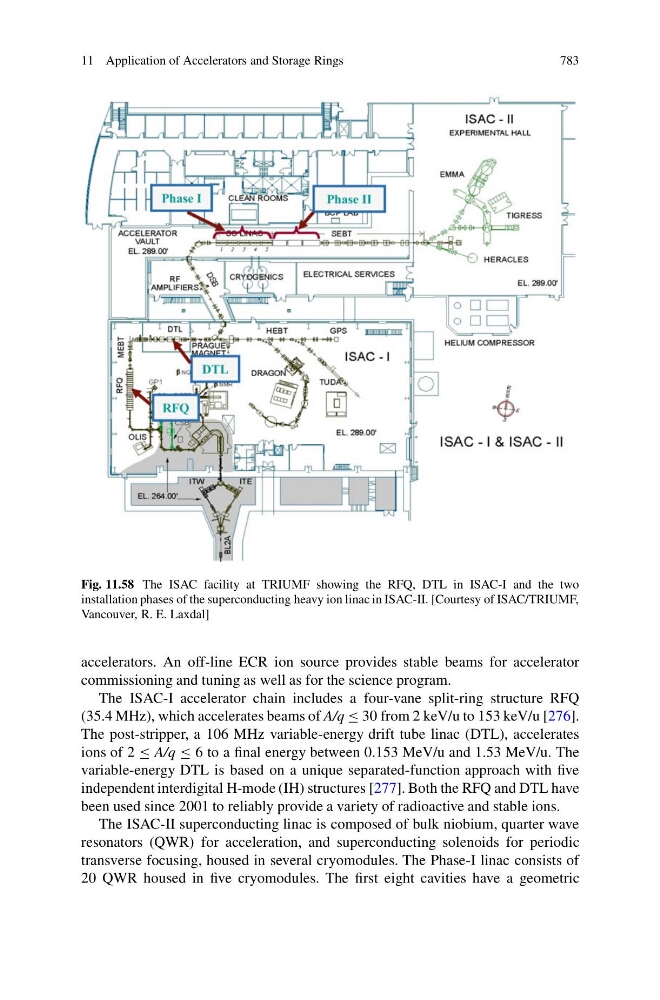
Fig. 11.58 The ISAC facility at TRIUMF showing the RFQ, DTL in ISAC-I and the two
installation phases of the superconducting heavy ion linac in ISAC-II. [Courtesy of ISAC/TRIUMF,
Vancouver, R. E. Laxdal]
accelerators. An off-line ECR ion source provides stable beams for accelerator
commissioning and tuning as well as for the science program.
The ISAC-I accelerator chain includes a four-vane split-ring structure RFQ
(35.4 MHz), which accelerates beams of A/q ≤ 30 from 2 keV/u to 153 keV/u [276].
The post-stripper, a 106 MHz variable-energy drift tube linac (DTL), accelerates
ions of 2 ≤ A/q ≤ 6 to a final energy between 0.153 MeV/u and 1.53 MeV/u. The
variable-energy DTL is based on a unique separated-function approach with five
independent interdigital H-mode (IH) structures [277]. Both the RFQ and DTL have
been used since 2001 to reliably provide a variety of radioactive and stable ions.
The ISAC-II superconducting linac is composed of bulk niobium, quarter wave
resonators (QWR) for acceleration, and superconducting solenoids for periodic
transverse focusing, housed in several cryomodules. The Phase-I linac consists of
20 QWR housed in five cryomodules. The first eight cavities have a geometric