

780
M. Dohlus et al.
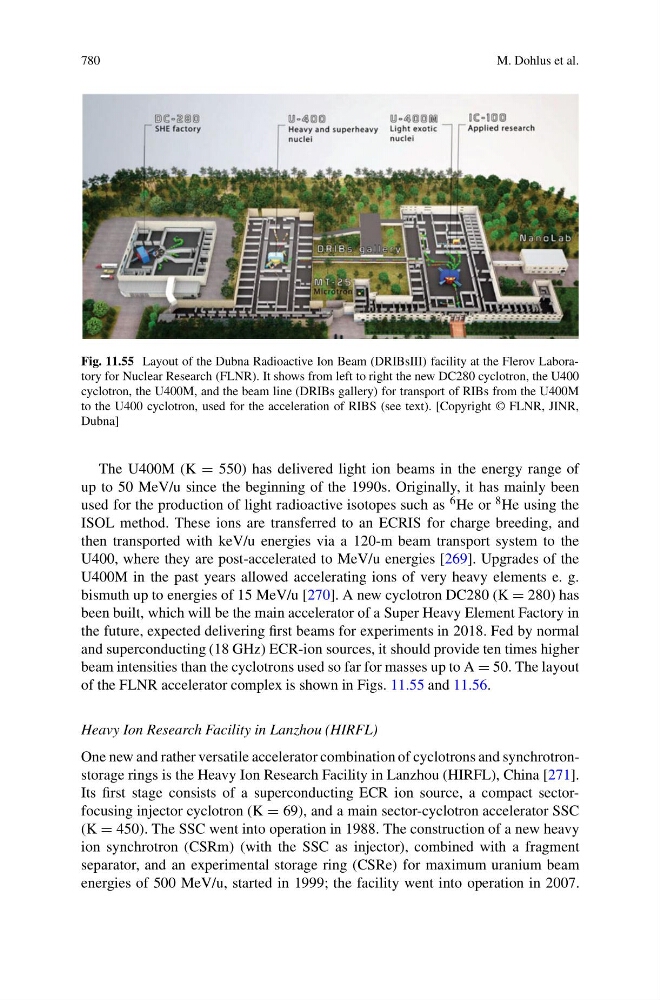
Fig. 11.55 Layout of the Dubna Radioactive Ion Beam (DRIBsIII) facility at the Flerov Laboratory for Nuclear Research (FLNR). It shows from left to right the new DC280 cyclotron, the U400
cyclotron, the U400M, and the beam line (DRIBs gallery) for transport of RIBs from the U400M
to the U400 cyclotron, used for the acceleration of RIBS (see text). [Copyright © FLNR, JINR,
Dubna]
The U400M (K = 550) has delivered light ion beams in the energy range of
up to 50 MeV/u since the beginning of the 1990s. Originally, it has mainly been
used for the production of light radioactive isotopes such as 6 He or 8 He using the
ISOL method. These ions are transferred to an ECRIS for charge breeding, and
then transported with keV/u energies via a 120-m beam transport system to the
U400, where they are post-accelerated to MeV/u energies [269]. Upgrades of the
U400M in the past years allowed accelerating ions of very heavy elements e. g.
bismuth up to energies of 15 MeV/u [270]. A new cyclotron DC280 (K = 280) has
been built, which will be the main accelerator of a Super Heavy Element Factory in
the future, expected delivering first beams for experiments in 2018. Fed by normal
and superconducting (18 GHz) ECR-ion sources, it should provide ten times higher
beam intensities than the cyclotrons used so far for masses up to A = 50. The layout
of the FLNR accelerator complex is shown in Figs. 11.55 and 11.56.
Heavy Ion Research Facility in Lanzhou (HIRFL)
One new and rather versatile accelerator combination of cyclotrons and synchrotronstorage rings is the Heavy Ion Research Facility in Lanzhou (HIRFL), China [271].
Its first stage consists of a superconducting ECR ion source, a compact sectorfocusing injector cyclotron (K = 69), and a main sector-cyclotron accelerator SSC
(K = 450). The SSC went into operation in 1988. The construction of a new heavy
ion synchrotron (CSRm) (with the SSC as injector), combined with a fragment
separator, and an experimental storage ring (CSRe) for maximum uranium beam
energies of 500 MeV/u, started in 1999; the facility went into operation in 2007.