

11 Application of Accelerators and Storage Rings
777
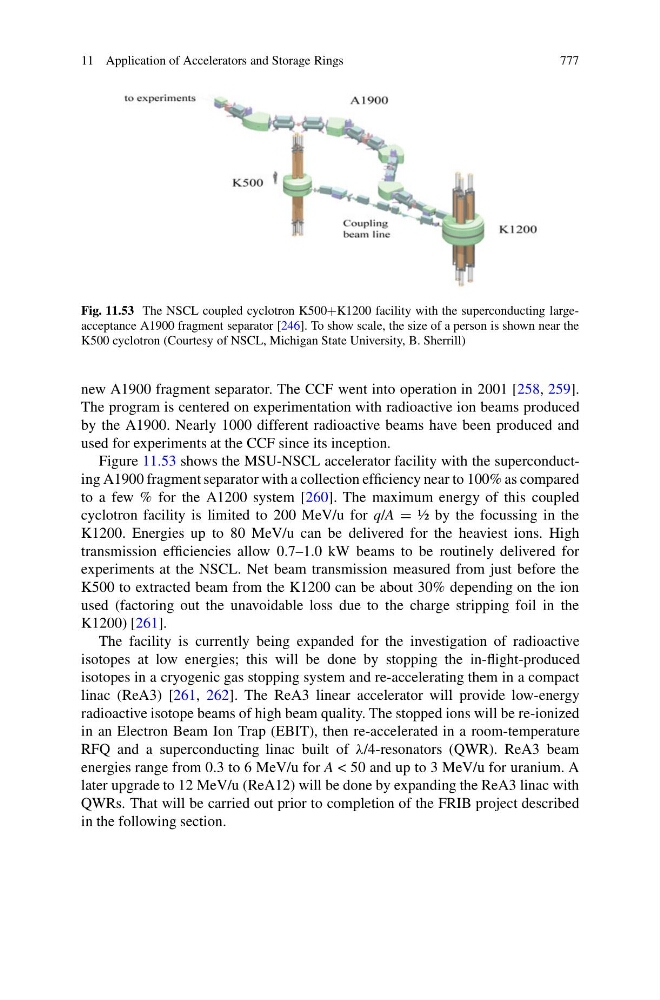
Fig. 11.53 The NSCL coupled cyclotron K500+K1200 facility with the superconducting largeacceptance A1900 fragment separator [246]. To show scale, the size of a person is shown near the
K500 cyclotron (Courtesy of NSCL, Michigan State University, B. Sherrill)
new A1900 fragment separator. The CCF went into operation in 2001 [258, 259].
The program is centered on experimentation with radioactive ion beams produced
by the A1900. Nearly 1000 different radioactive beams have been produced and
used for experiments at the CCF since its inception.
Figure 11.53 shows the MSU-NSCL accelerator facility with the superconducting A1900 fragment separator with a collection efficiency near to 100% as compared
to a few % for the A1200 system [260]. The maximum energy of this coupled
cyclotron facility is limited to 200 MeV/u for q/A = ½ by the focussing in the
K1200. Energies up to 80 MeV/u can be delivered for the heaviest ions. High
transmission efficiencies allow 0.7–1.0 kW beams to be routinely delivered for
experiments at the NSCL. Net beam transmission measured from just before the
K500 to extracted beam from the K1200 can be about 30% depending on the ion
used (factoring out the unavoidable loss due to the charge stripping foil in the
K1200) [261].
The facility is currently being expanded for the investigation of radioactive
isotopes at low energies; this will be done by stopping the in-flight-produced
isotopes in a cryogenic gas stopping system and re-accelerating them in a compact
linac (ReA3) [261, 262]. The ReA3 linear accelerator will provide low-energy
radioactive isotope beams of high beam quality. The stopped ions will be re-ionized
in an Electron Beam Ion Trap (EBIT), then re-accelerated in a room-temperature
RFQ and a superconducting linac built of λ/4-resonators (QWR). ReA3 beam
energies range from 0.3 to 6 MeV/u for A < 50 and up to 3 MeV/u for uranium. A
later upgrade to 12 MeV/u (ReA12) will be done by expanding the ReA3 linac with
QWRs. That will be carried out prior to completion of the FRIB project described
in the following section.