

776
M. Dohlus et al.
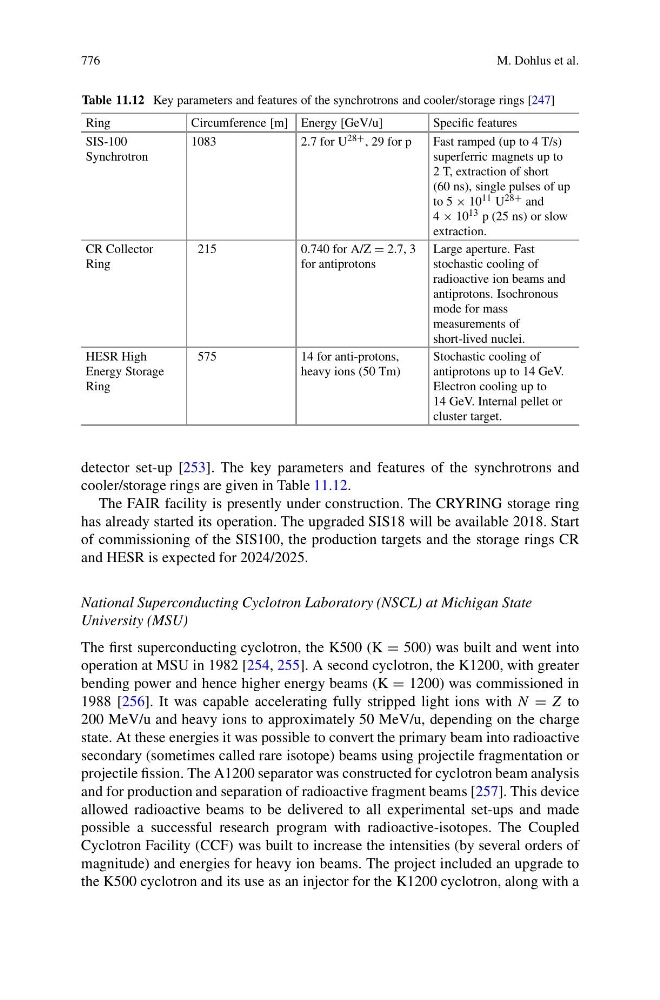
Table 11.12 Key parameters and features of the synchrotrons and cooler/storage rings [247]
Ring
Circumference [m] Energy [GeV/u]
Specific features
SIS-100
Synchrotron
1083
2.7 for U 28+ , 29 for p
Fast ramped (up to 4 T/s)
superferric magnets up to
2 T, extraction of short
(60 ns), single pulses of up
to 5 × 10 11 U 28+ and
4 × 10 13 p (25 ns) or slow
extraction.
CR Collector
Ring
215
0.740 for A/Z = 2.7, 3
for antiprotons
Large aperture. Fast
stochastic cooling of
radioactive ion beams and
antiprotons. Isochronous
mode for mass
measurements of
short-lived nuclei.
HESR High
Energy Storage
Ring
575
14 for anti-protons,
heavy ions (50 Tm)
Stochastic cooling of
antiprotons up to 14 GeV.
Electron cooling up to
14 GeV. Internal pellet or
cluster target.
detector set-up [253]. The key parameters and features of the synchrotrons and
cooler/storage rings are given in Table 11.12.
The FAIR facility is presently under construction. The CRYRING storage ring
has already started its operation. The upgraded SIS18 will be available 2018. Start
of commissioning of the SIS100, the production targets and the storage rings CR
and HESR is expected for 2024/2025.
National Superconducting Cyclotron Laboratory (NSCL) at Michigan State
University (MSU)
The first superconducting cyclotron, the K500 (K = 500) was built and went into
operation at MSU in 1982 [254, 255]. A second cyclotron, the K1200, with greater
bending power and hence higher energy beams (K = 1200) was commissioned in
1988 [256]. It was capable accelerating fully stripped light ions with N = Z to
200 MeV/u and heavy ions to approximately 50 MeV/u, depending on the charge
state. At these energies it was possible to convert the primary beam into radioactive
secondary (sometimes called rare isotope) beams using projectile fragmentation or
projectile fission. The A1200 separator was constructed for cyclotron beam analysis
and for production and separation of radioactive fragment beams [257]. This device
allowed radioactive beams to be delivered to all experimental set-ups and made
possible a successful research program with radioactive-isotopes. The Coupled
Cyclotron Facility (CCF) was built to increase the intensities (by several orders of
magnitude) and energies for heavy ion beams. The project included an upgrade to
the K500 cyclotron and its use as an injector for the K1200 cyclotron, along with a