

11 Application of Accelerators and Storage Rings
775
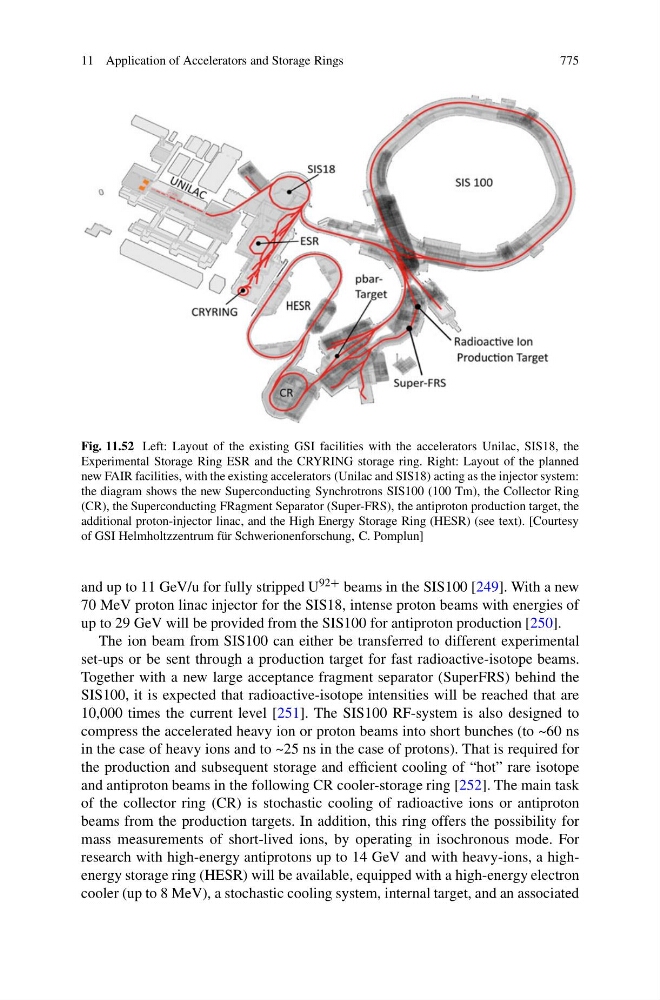
Fig. 11.52 Left: Layout of the existing GSI facilities with the accelerators Unilac, SIS18, the
Experimental Storage Ring ESR and the CRYRING storage ring. Right: Layout of the planned
new FAIR facilities, with the existing accelerators (Unilac and SIS18) acting as the injector system:
the diagram shows the new Superconducting Synchrotrons SIS100 (100 Tm), the Collector Ring
(CR), the Superconducting FRagment Separator (Super-FRS), the antiproton production target, the
additional proton-injector linac, and the High Energy Storage Ring (HESR) (see text). [Courtesy
of GSI Helmholtzzentrum für Schwerionenforschung, C. Pomplun]
and up to 11 GeV/u for fully stripped U 92+ beams in the SIS100 [249]. With a new
70 MeV proton linac injector for the SIS18, intense proton beams with energies of
up to 29 GeV will be provided from the SIS100 for antiproton production [250].
The ion beam from SIS100 can either be transferred to different experimental
set-ups or be sent through a production target for fast radioactive-isotope beams.
Together with a new large acceptance fragment separator (SuperFRS) behind the
SIS100, it is expected that radioactive-isotope intensities will be reached that are
10,000 times the current level [251]. The SIS100 RF-system is also designed to
compress the accelerated heavy ion or proton beams into short bunches (to ~60 ns
in the case of heavy ions and to ~25 ns in the case of protons). That is required for
the production and subsequent storage and efficient cooling of “hot” rare isotope
and antiproton beams in the following CR cooler-storage ring [252]. The main task
of the collector ring (CR) is stochastic cooling of radioactive ions or antiproton
beams from the production targets. In addition, this ring offers the possibility for
mass measurements of short-lived ions, by operating in isochronous mode. For
research with high-energy antiprotons up to 14 GeV and with heavy-ions, a highenergy storage ring (HESR) will be available, equipped with a high-energy electron
cooler (up to 8 MeV), a stochastic cooling system, internal target, and an associated