

774
M. Dohlus et al.
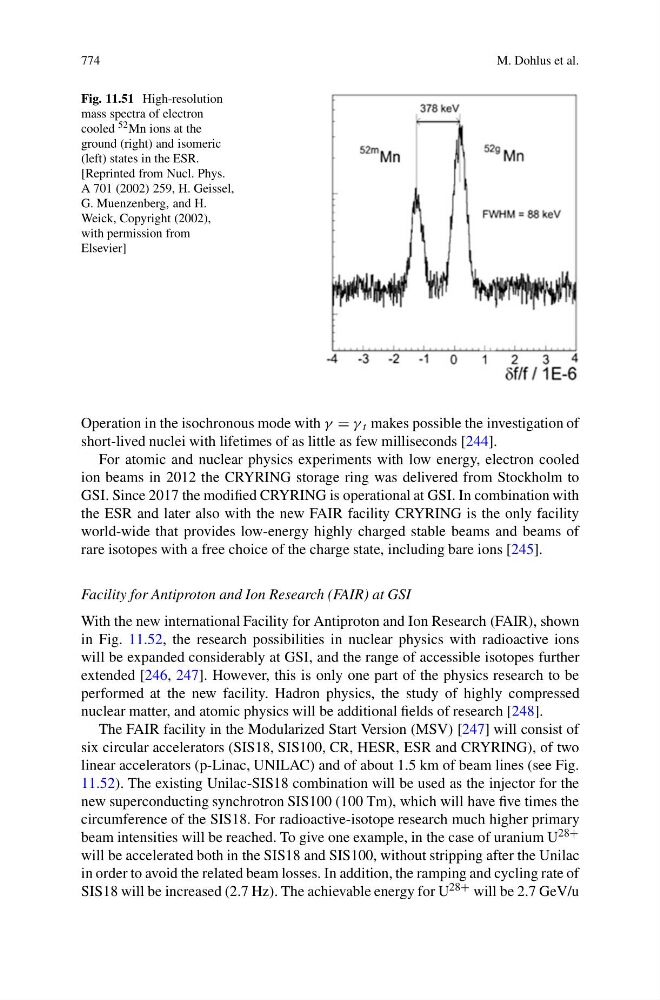
Fig. 11.51 High-resolution
mass spectra of electron
cooled 52 Mn ions at the
ground (right) and isomeric
(left) states in the ESR.
[Reprinted from Nucl. Phys.
A 701 (2002) 259, H. Geissel,
G. Muenzenberg, and H.
Weick, Copyright (2002),
with permission from
Elsevier]
Operation in the isochronous mode with γ = γ t makes possible the investigation of
short-lived nuclei with lifetimes of as little as few milliseconds [244].
For atomic and nuclear physics experiments with low energy, electron cooled
ion beams in 2012 the CRYRING storage ring was delivered from Stockholm to
GSI. Since 2017 the modified CRYRING is operational at GSI. In combination with
the ESR and later also with the new FAIR facility CRYRING is the only facility
world-wide that provides low-energy highly charged stable beams and beams of
rare isotopes with a free choice of the charge state, including bare ions [245].
Facility for Antiproton and Ion Research (FAIR) at GSI
With the new international Facility for Antiproton and Ion Research (FAIR), shown
in Fig. 11.52, the research possibilities in nuclear physics with radioactive ions
will be expanded considerably at GSI, and the range of accessible isotopes further
extended [246, 247]. However, this is only one part of the physics research to be
performed at the new facility. Hadron physics, the study of highly compressed
nuclear matter, and atomic physics will be additional fields of research [248].
The FAIR facility in the Modularized Start Version (MSV) [247] will consist of
six circular accelerators (SIS18, SIS100, CR, HESR, ESR and CRYRING), of two
linear accelerators (p-Linac, UNILAC) and of about 1.5 km of beam lines (see Fig.
11.52). The existing Unilac-SIS18 combination will be used as the injector for the
new superconducting synchrotron SIS100 (100 Tm), which will have five times the
circumference of the SIS18. For radioactive-isotope research much higher primary
beam intensities will be reached. To give one example, in the case of uranium U 28+
will be accelerated both in the SIS18 and SIS100, without stripping after the Unilac
in order to avoid the related beam losses. In addition, the ramping and cycling rate of
SIS18 will be increased (2.7 Hz). The achievable energy for U 28+ will be 2.7 GeV/u