

11 Application of Accelerators and Storage Rings
773
same velocity, with extremely small velocity spread [239]. Therefore, the frequency
spectrum of the beam noise (Schottky spectrum) from the multi-component beam
stored in the ESR consists of clearly separated lines. The frequency differences
between the lines are determined only by the mass-to-charge ratio A/q. The
difference in the revolution frequency (or revolution time) between ions of varying
A/q ratios is given by
Δf
f
= −
ΔT
T
= −
1
γ 2
t
Δ (A/q)
A/q
+
1 −
γ 2
γ 2
t
Δv
v
.
(11.92)
where γ t is the transition energy and Δv/v is the velocity spread in the ion beam;
the velocity spread can be reduced by stochastic or electron cooling. The best
results in terms of accuracy and resolution are achieved with electron cooling at
very low beam intensities, and when the number of total stored ions within a small
A/q-interval is below 1000 (this minimizes the counteracting effect of intra-beam
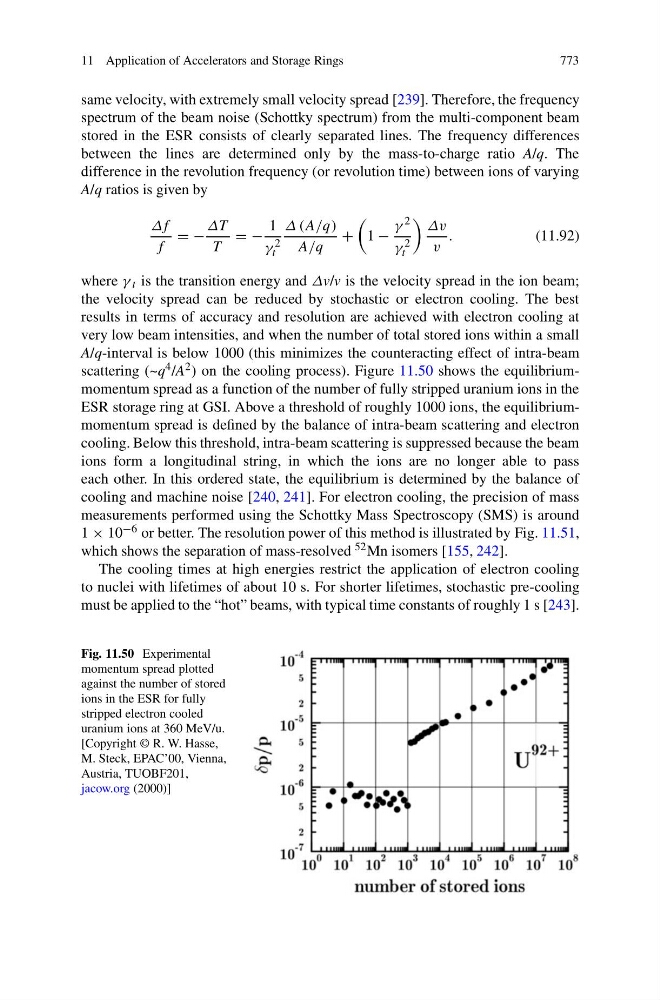
scattering (~q 4 /A 2 ) on the cooling process). Figure 11.50 shows the equilibriummomentum spread as a function of the number of fully stripped uranium ions in the
ESR storage ring at GSI. Above a threshold of roughly 1000 ions, the equilibriummomentum spread is defined by the balance of intra-beam scattering and electron
cooling. Below this threshold, intra-beam scattering is suppressed because the beam
ions form a longitudinal string, in which the ions are no longer able to pass
each other. In this ordered state, the equilibrium is determined by the balance of
cooling and machine noise [240, 241]. For electron cooling, the precision of mass
measurements performed using the Schottky Mass Spectroscopy (SMS) is around
1 × 10 −6 or better. The resolution power of this method is illustrated by Fig. 11.51,
which shows the separation of mass-resolved 52 Mn isomers [155, 242].
The cooling times at high energies restrict the application of electron cooling
to nuclei with lifetimes of about 10 s. For shorter lifetimes, stochastic pre-cooling
must be applied to the “hot” beams, with typical time constants of roughly 1 s [243].
Fig. 11.50 Experimental
momentum spread plotted
against the number of stored
ions in the ESR for fully
stripped electron cooled
uranium ions at 360 MeV/u.
[Copyright © R. W. Hasse,
M. Steck, EPAC’00, Vienna,
Austria, TUOBF201,
jacow.org (2000)]