

772
M. Dohlus et al.
Construction of the synchrotron storage ring facility [225] started in 1985; it
went into operation in 1990 [226, 227]. The synchrotron SIS18 delivers U 72+ beams
(foil stripped after the Unilac at 11.4 MeV/u) at energies of up to 1 GeV/u; U 92+ -
ions (using stripping at 1 GeV/u and re-injection into the SIS18 via the ESR) are
delivered at energies of up to 1.4 GeV/u. Light ion beams (q/A = 1/2) can be
accelerated at energies of up to 2 GeV/u. Beam intensities currently range from
10 10 ions (for heavy elements) to 10 11 ions (for light elements) per synchrotron
cycle (1 Hz). The Unilac and the SIS18 will be used as the injector system in the
Facility for Antiproton and Ion Research (FAIR) (Fig. 11.52 below). Intensities are
being increased using a current upgrade program for injection in FAIR (see section
“Facility for Antiproton and Ion Research (FAIR) at GSI”).
Experiments with in-flight-produced isotopes are performed both at Unilac and
SIS18 energies. Super-heavy elements, produced with low-energy Unilac beams
using fusion reactions in very thin heavy targets, move forward with the centerof-mass energy. They are analyzed in an electromagnetic separator (SHIP) before
being stopped in a detector, or investigated at rest in an ion trap, or separated
using chemical methods [148]. Fast radioactive isotopes produced by means of
the projectile fragmentation of SIS18 beams in a thin target are analyzed in
the FRagment Separator (FRS) [238]. The isotopes thus analyzed can either be
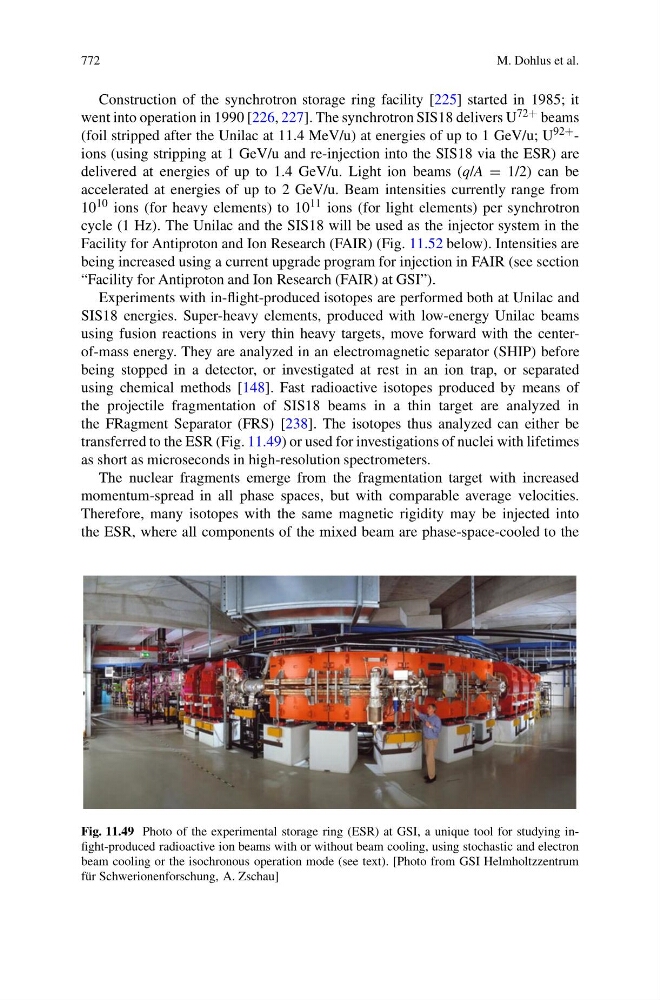
transferred to the ESR (Fig. 11.49) or used for investigations of nuclei with lifetimes
as short as microseconds in high-resolution spectrometers.
The nuclear fragments emerge from the fragmentation target with increased
momentum-spread in all phase spaces, but with comparable average velocities.
Therefore, many isotopes with the same magnetic rigidity may be injected into
the ESR, where all components of the mixed beam are phase-space-cooled to the
Fig. 11.49 Photo of the experimental storage ring (ESR) at GSI, a unique tool for studying infight-produced radioactive ion beams with or without beam cooling, using stochastic and electron
beam cooling or the isochronous operation mode (see text). [Photo from GSI Helmholtzzentrum
für Schwerionenforschung, A. Zschau]