

11 Application of Accelerators and Storage Rings
771
Recently the main focus of accelerator development has been on improving the
heavy ion beam intensities by optimizing the accelerator tuning and by reducing
matching and transmission losses in the individual stages. Overall transmission for
light ions is now approaching 100%. Construction of a second linac for the RRC
(RILAC2) began in 2008, fed from a new superconducting 28-GHz ECR ion source,
to provide an independent choice of ion beams for rare isotope physics and superheavy element research [224].
GSI Accelerator Facility (Unilac, SIS18, ESR)
The accelerator facility at the GSI Helmholtzzentrum for heavy ion research, Darmstadt, Germany, (see Fig. 11.52 below), consists of the universal heavy ion linear
accelerator (Unilac), the heavy ion synchrotron SIS18 (Schwer-Ionen-Synchrotron,
18 Tm), and the Experimental Storage Ring (ESR, 10 Tm). Construction of the
Unilac started in 1970 [229, 230]. The first heavy ions were accelerated in 1975,
and uranium ions in 1976 [231]. The Unilac can deliver beams with energies
>12.5 MeV/u for all elements up to uranium. Upgrade measures were performed
for beam energy in the 1980s and for beam intensity in the 1990s [232]. The present
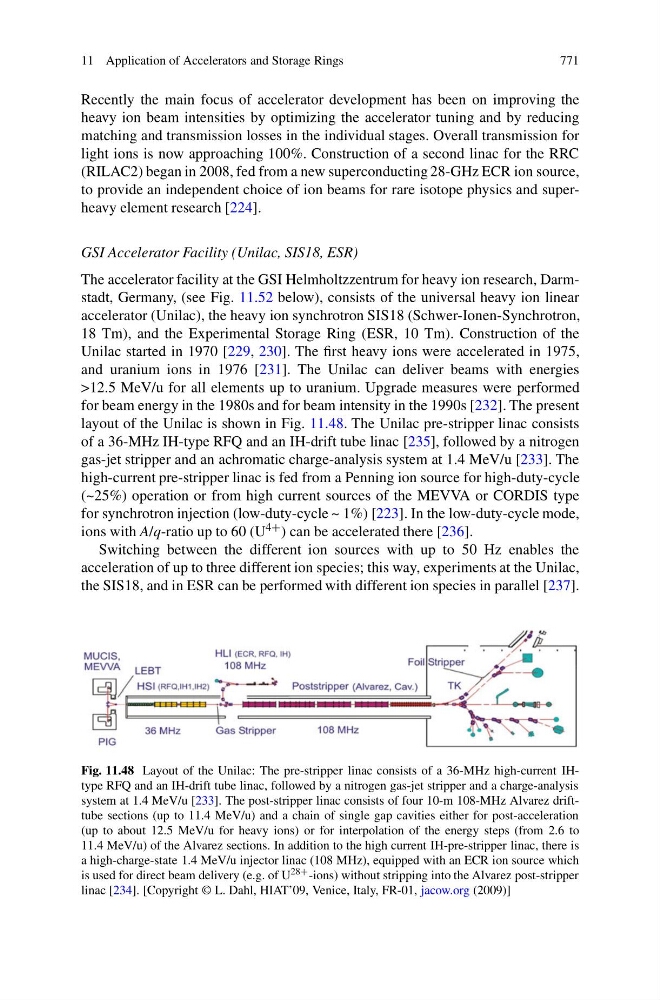
layout of the Unilac is shown in Fig. 11.48. The Unilac pre-stripper linac consists
of a 36-MHz IH-type RFQ and an IH-drift tube linac [235], followed by a nitrogen
gas-jet stripper and an achromatic charge-analysis system at 1.4 MeV/u [233]. The
high-current pre-stripper linac is fed from a Penning ion source for high-duty-cycle
(~25%) operation or from high current sources of the MEVVA or CORDIS type
for synchrotron injection (low-duty-cycle ~ 1%) [223]. In the low-duty-cycle mode,
ions with A/q-ratio up to 60 (U 4+ ) can be accelerated there [236].
Switching between the different ion sources with up to 50 Hz enables the
acceleration of up to three different ion species; this way, experiments at the Unilac,
the SIS18, and in ESR can be performed with different ion species in parallel [237].
Fig. 11.48 Layout of the Unilac: The pre-stripper linac consists of a 36-MHz high-current IHtype RFQ and an IH-drift tube linac, followed by a nitrogen gas-jet stripper and a charge-analysis
system at 1.4 MeV/u [233]. The post-stripper linac consists of four 10-m 108-MHz Alvarez drifttube sections (up to 11.4 MeV/u) and a chain of single gap cavities either for post-acceleration
(up to about 12.5 MeV/u for heavy ions) or for interpolation of the energy steps (from 2.6 to
11.4 MeV/u) of the Alvarez sections. In addition to the high current IH-pre-stripper linac, there is
a high-charge-state 1.4 MeV/u injector linac (108 MHz), equipped with an ECR ion source which
is used for direct beam delivery (e.g. of U 28+ -ions) without stripping into the Alvarez post-stripper
linac [234]. [Copyright © L. Dahl, HIAT’09, Venice, Italy, FR-01, jacow.org (2009)]