

770
M. Dohlus et al.
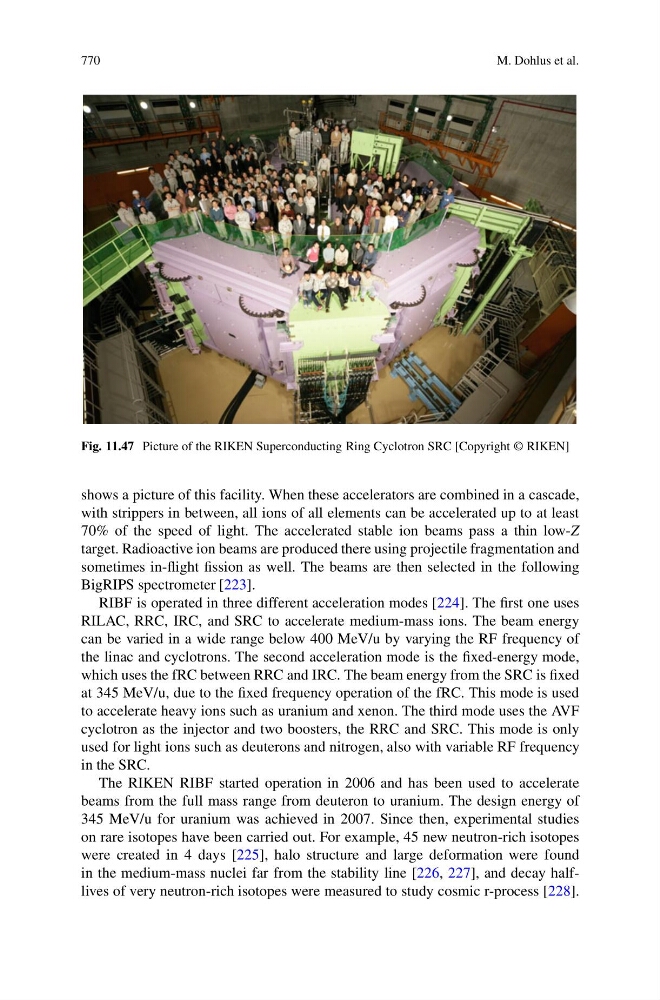
Fig. 11.47 Picture of the RIKEN Superconducting Ring Cyclotron SRC [Copyright © RIKEN]
shows a picture of this facility. When these accelerators are combined in a cascade,
with strippers in between, all ions of all elements can be accelerated up to at least
70% of the speed of light. The accelerated stable ion beams pass a thin low-Z
target. Radioactive ion beams are produced there using projectile fragmentation and
sometimes in-flight fission as well. The beams are then selected in the following
BigRIPS spectrometer [223].
RIBF is operated in three different acceleration modes [224]. The first one uses
RILAC, RRC, IRC, and SRC to accelerate medium-mass ions. The beam energy
can be varied in a wide range below 400 MeV/u by varying the RF frequency of
the linac and cyclotrons. The second acceleration mode is the fixed-energy mode,
which uses the fRC between RRC and IRC. The beam energy from the SRC is fixed
at 345 MeV/u, due to the fixed frequency operation of the fRC. This mode is used
to accelerate heavy ions such as uranium and xenon. The third mode uses the AVF
cyclotron as the injector and two boosters, the RRC and SRC. This mode is only
used for light ions such as deuterons and nitrogen, also with variable RF frequency
in the SRC.
The RIKEN RIBF started operation in 2006 and has been used to accelerate
beams from the full mass range from deuteron to uranium. The design energy of
345 MeV/u for uranium was achieved in 2007. Since then, experimental studies
on rare isotopes have been carried out. For example, 45 new neutron-rich isotopes
were created in 4 days [225], halo structure and large deformation were found
in the medium-mass nuclei far from the stability line [226, 227], and decay halflives of very neutron-rich isotopes were measured to study cosmic r-process [228].