

11 Application of Accelerators and Storage Rings
765
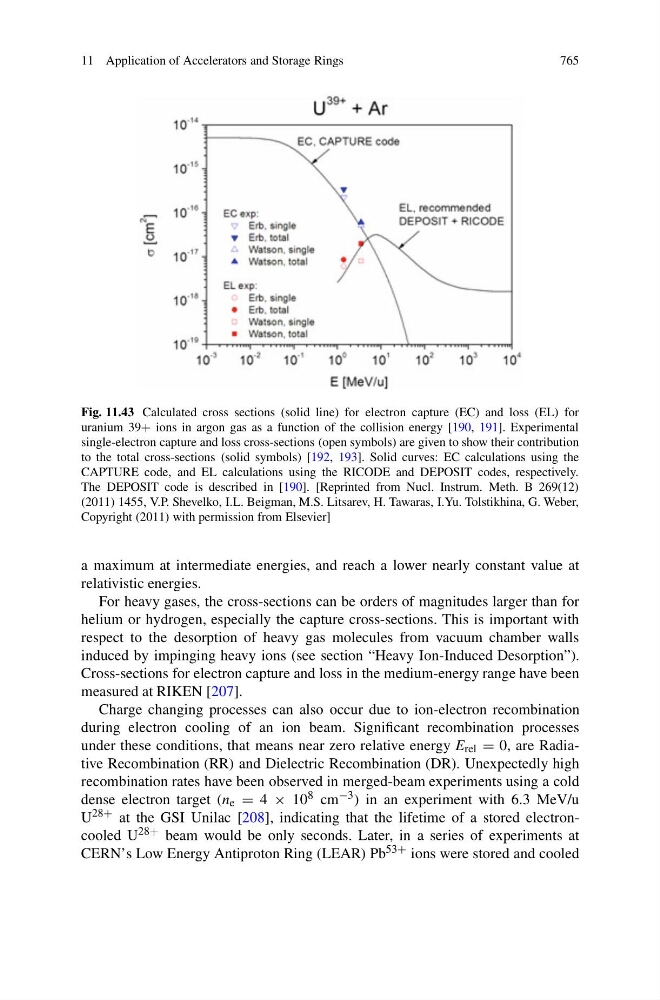
Fig. 11.43 Calculated cross sections (solid line) for electron capture (EC) and loss (EL) for
uranium 39+ ions in argon gas as a function of the collision energy [190, 191]. Experimental
single-electron capture and loss cross-sections (open symbols) are given to show their contribution
to the total cross-sections (solid symbols) [192, 193]. Solid curves: EC calculations using the
CAPTURE code, and EL calculations using the RICODE and DEPOSIT codes, respectively.
The DEPOSIT code is described in [190]. [Reprinted from Nucl. Instrum. Meth. B 269(12)
(2011) 1455, V.P. Shevelko, I.L. Beigman, M.S. Litsarev, H. Tawaras, I.Yu. Tolstikhina, G. Weber,
Copyright (2011) with permission from Elsevier]
a maximum at intermediate energies, and reach a lower nearly constant value at
relativistic energies.
For heavy gases, the cross-sections can be orders of magnitudes larger than for
helium or hydrogen, especially the capture cross-sections. This is important with
respect to the desorption of heavy gas molecules from vacuum chamber walls
induced by impinging heavy ions (see section “Heavy Ion-Induced Desorption”).
Cross-sections for electron capture and loss in the medium-energy range have been
measured at RIKEN [207].
Charge changing processes can also occur due to ion-electron recombination
during electron cooling of an ion beam. Significant recombination processes
under these conditions, that means near zero relative energy E rel = 0, are Radiative Recombination (RR) and Dielectric Recombination (DR). Unexpectedly high
recombination rates have been observed in merged-beam experiments using a cold
dense electron target (n e = 4 × 10 8 cm −3 ) in an experiment with 6.3 MeV/u
U 28+ at the GSI Unilac [208], indicating that the lifetime of a stored electroncooled U 28+ beam would be only seconds. Later, in a series of experiments at
CERN’s Low Energy Antiproton Ring (LEAR) Pb 53+ ions were stored and cooled