

766
M. Dohlus et al.
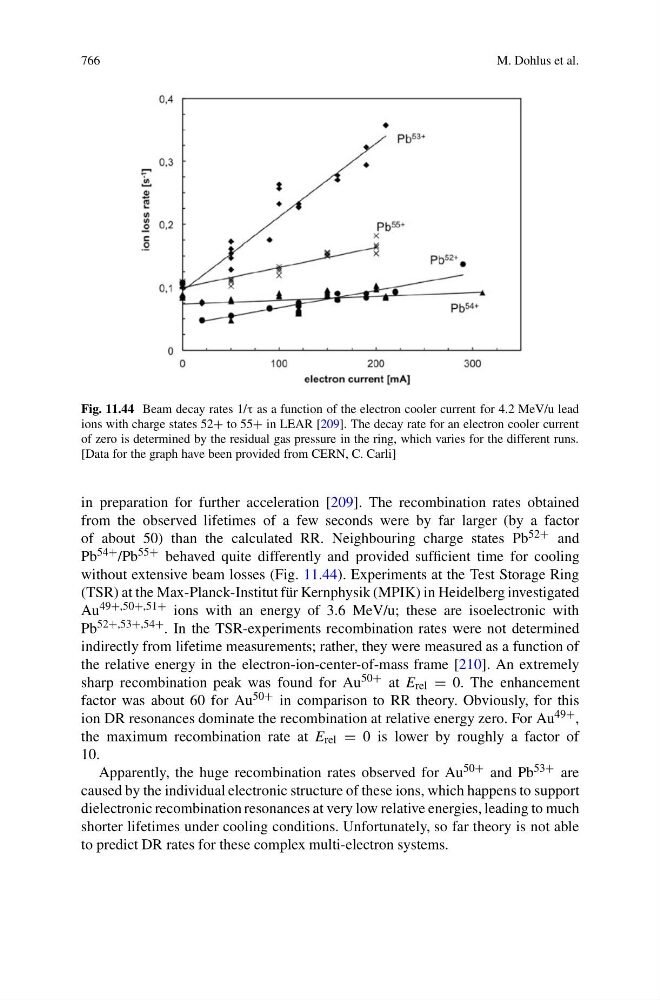
Fig. 11.44 Beam decay rates 1/τ as a function of the electron cooler current for 4.2 MeV/u lead
ions with charge states 52+ to 55+ in LEAR [209]. The decay rate for an electron cooler current
of zero is determined by the residual gas pressure in the ring, which varies for the different runs.
[Data for the graph have been provided from CERN, C. Carli]
in preparation for further acceleration [209]. The recombination rates obtained
from the observed lifetimes of a few seconds were by far larger (by a factor
of about 50) than the calculated RR. Neighbouring charge states Pb 52+ and
Pb 54+ /Pb 55+ behaved quite differently and provided sufficient time for cooling
without extensive beam losses (Fig. 11.44). Experiments at the Test Storage Ring
(TSR) at the Max-Planck-Institut für Kernphysik (MPIK) in Heidelberg investigated
Au 49+,50+,51+ ions with an energy of 3.6 MeV/u; these are isoelectronic with
Pb 52+,53+,54+ . In the TSR-experiments recombination rates were not determined
indirectly from lifetime measurements; rather, they were measured as a function of
the relative energy in the electron-ion-center-of-mass frame [210]. An extremely
sharp recombination peak was found for Au 50+ at E rel = 0. The enhancement
factor was about 60 for Au 50+ in comparison to RR theory. Obviously, for this
ion DR resonances dominate the recombination at relative energy zero. For Au 49+ ,
the maximum recombination rate at E rel = 0 is lower by roughly a factor of
10.
Apparently, the huge recombination rates observed for Au 50+ and Pb 53+ are
caused by the individual electronic structure of these ions, which happens to support
dielectronic recombination resonances at very low relative energies, leading to much
shorter lifetimes under cooling conditions. Unfortunately, so far theory is not able
to predict DR rates for these complex multi-electron systems.