

764
M. Dohlus et al.
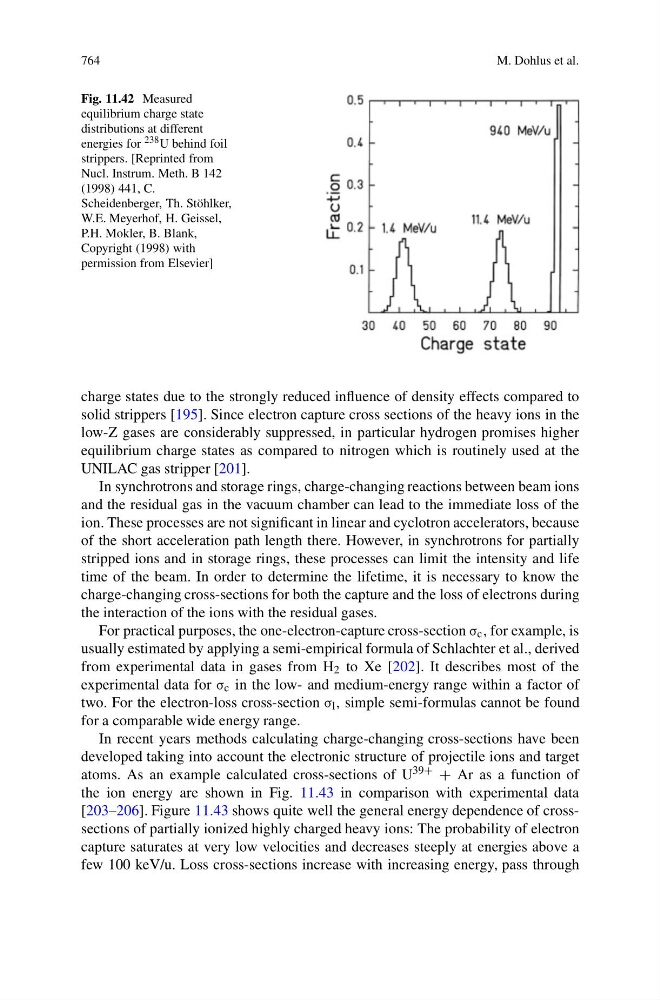
Fig. 11.42 Measured
equilibrium charge state
distributions at different
energies for 238 U behind foil
strippers. [Reprinted from
Nucl. Instrum. Meth. B 142
(1998) 441, C.
Scheidenberger, Th. Stöhlker,
W.E. Meyerhof, H. Geissel,
P.H. Mokler, B. Blank,
Copyright (1998) with
permission from Elsevier]
charge states due to the strongly reduced influence of density effects compared to
solid strippers [195]. Since electron capture cross sections of the heavy ions in the
low-Z gases are considerably suppressed, in particular hydrogen promises higher
equilibrium charge states as compared to nitrogen which is routinely used at the
UNILAC gas stripper [201].
In synchrotrons and storage rings, charge-changing reactions between beam ions
and the residual gas in the vacuum chamber can lead to the immediate loss of the
ion. These processes are not significant in linear and cyclotron accelerators, because
of the short acceleration path length there. However, in synchrotrons for partially
stripped ions and in storage rings, these processes can limit the intensity and life
time of the beam. In order to determine the lifetime, it is necessary to know the
charge-changing cross-sections for both the capture and the loss of electrons during
the interaction of the ions with the residual gases.
For practical purposes, the one-electron-capture cross-section σ c , for example, is
usually estimated by applying a semi-empirical formula of Schlachter et al., derived
from experimental data in gases from H 2 to Xe [202]. It describes most of the
experimental data for σ c in the low- and medium-energy range within a factor of
two. For the electron-loss cross-section σ l , simple semi-formulas cannot be found
for a comparable wide energy range.
In recent years methods calculating charge-changing cross-sections have been
developed taking into account the electronic structure of projectile ions and target
atoms. As an example calculated cross-sections of U 39+ + Ar as a function of
the ion energy are shown in Fig. 11.43 in comparison with experimental data
[203–206]. Figure 11.43 shows quite well the general energy dependence of crosssections of partially ionized highly charged heavy ions: The probability of electron
capture saturates at very low velocities and decreases steeply at energies above a
few 100 keV/u. Loss cross-sections increase with increasing energy, pass through