

11 Application of Accelerators and Storage Rings
689
The FEL gain function is defined as the relative increase in light intensity during
one passage of the undulator: G = (I − I 0 ) /I 0 =
˜
E x /E 0
2 − 1. The gain is
proportional to the negative derivative of the line-shape curve of undulator radiation
(Madey theorem) [17]
G (ξ ) = −
πe 2 ˆ
K 2 N 2
u λ 2
u n e
4ε 0 m e c 2 γ 3
r
·
d
dξ
sin 2 ξ
ξ 2
,
(11.70)
with the detuning ξ = πN u η, n e the number of electrons per unit volume and N u the
number of undulator periods.
Low Gain FELs
Low gain FELs like the infrared FEL at JLAB consist of a short undulator in an
optical cavity fed by a multi bunch source. Upon each bunch passage through the
undulator the light intensity grows by only a few per cent, but after very many round
trips a large average FEL beam power can be achieved, e.g. more than 10 kW in the
infrared FEL at JLAB [16, 18].
11.1.2.1.2 High-Gain FEL Theory
For wavelengths far below the visible it is not possible to build optical cavities. An
option is then making the undulator much longer, such that the gain during a single
passage becomes attractive and an optical cavity arrangement becomes obsolete. In
this case, the low-gain assumption |G| < < 1 cannot be made any more, meaning
that the stimulation and propagation of electromagnetic waves must be taken into
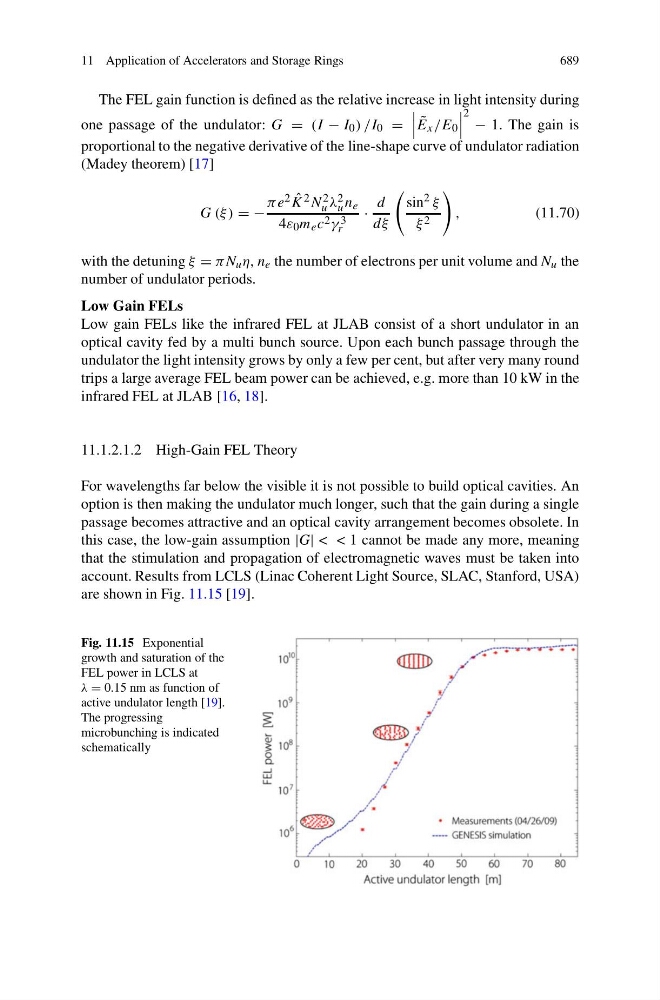
account. Results from LCLS (Linac Coherent Light Source, SLAC, Stanford, USA)
are shown in Fig. 11.15 [19].
Fig. 11.15 Exponential
growth and saturation of the
FEL power in LCLS at
λ = 0.15 nm as function of
active undulator length [19].
The progressing
microbunching is indicated
schematically