

690
M. Dohlus et al.
Some important effects as microbunching, exponential growth and saturation
of the FEL power and even the start-up-from-shot-noise can be studied with
help of the one dimensional periodic model Eq. (11.62). The equations for
d
dz ψ ν
and
d
dz η ν are the same as for the low gain case (Eqs. 11.68 and 11.69). The
stimulation of the electric field amplitude is calculated with help of the wave
equation.
Wave Equation
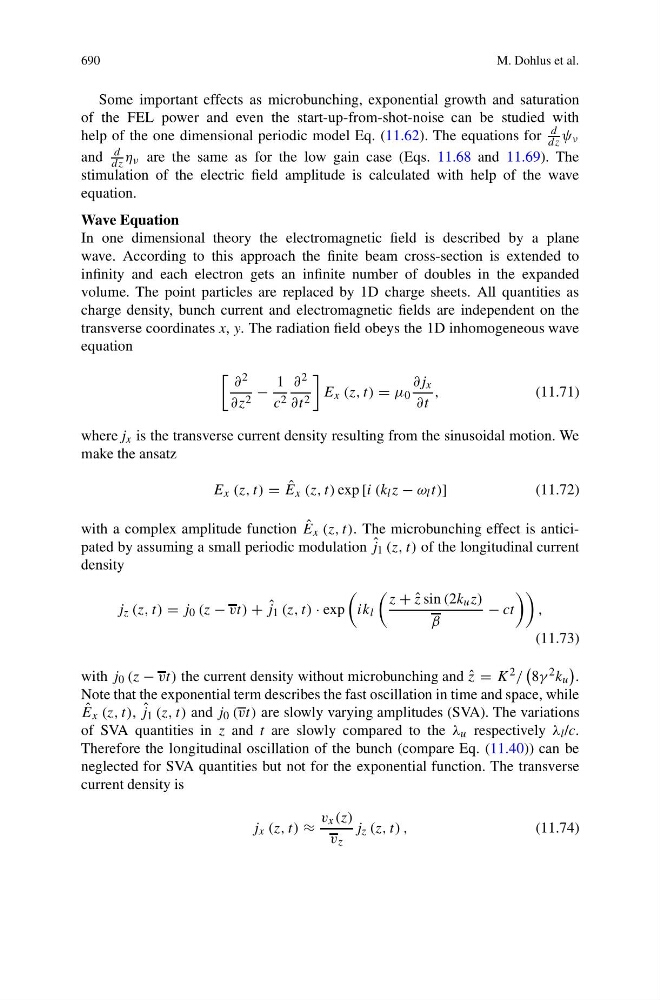
In one dimensional theory the electromagnetic field is described by a plane
wave. According to this approach the finite beam cross-section is extended to
infinity and each electron gets an infinite number of doubles in the expanded
volume. The point particles are replaced by 1D charge sheets. All quantities as
charge density, bunch current and electromagnetic fields are independent on the
transverse coordinates x, y. The radiation field obeys the 1D inhomogeneous wave
equation
∂ 2
∂z 2 −
1
c 2
∂ 2
∂t 2
E x (z, t) = μ 0
∂j x
∂t
,
(11.71)
where j x is the transverse current density resulting from the sinusoidal motion. We
make the ansatz
E x (z, t) = ˆ
E x (z, t) exp [i (k l z − ω l t)]
(11.72)
with a complex amplitude function ˆ
E x (z, t). The microbunching effect is anticipated by assuming a small periodic modulation ˆ
j 1 (z, t) of the longitudinal current
density
j z (z, t) = j 0 (z − vt) + ˆ
j 1 (z, t) · exp
ik l
z + ˆ
z sin (2k u z)
β
− ct
,
(11.73)
with j 0 (z − vt) the current density without microbunching and ˆ
z = K 2 /
8γ 2 k u
.
Note that the exponential term describes the fast oscillation in time and space, while
ˆ
E x (z, t), ˆ
j 1 (z, t) and j 0 (vt) are slowly varying amplitudes (SVA). The variations
of SVA quantities in z and t are slowly compared to the λ u respectively λ l /c.
Therefore the longitudinal oscillation of the bunch (compare Eq. (11.40)) can be
neglected for SVA quantities but not for the exponential function. The transverse
current density is
j x (z, t) ≈
v x (z)
v z
j z (z, t) ,
(11.74)