

688
M. Dohlus et al.
We rewrite Eq. (11.66) for η(z) = (γ − γ r )/γ r with z = vt as independent
coordinate to get an equation of the required type:
dη
dz
= −e
ˆ
K
2γ 2 m e c 2 Re {E 0 exp (iψ 0 ) exp (iψ)} .
(11.68)
Additional to the wave phase ψ 0 we consider the ponderomotive phase ψ which
is individual per particle. This reflects that an arbitrary particle can be shifted in time
relative to the “reference” particle with the trajectory x(t), z(t).
The slip = k l (v z ((1 + η) γ r ) − v z (γ r )) T u of the ponderomotive phase in
one undulator period due to η is caused by the energy dependency of the average
longitudinal velocity Eq. (11.41). Therefore the longitudinal dispersion is in linear
approximation
dψ
dz
= 2k u η.
(11.69)
FEL Pendulum Equations and Gain Function
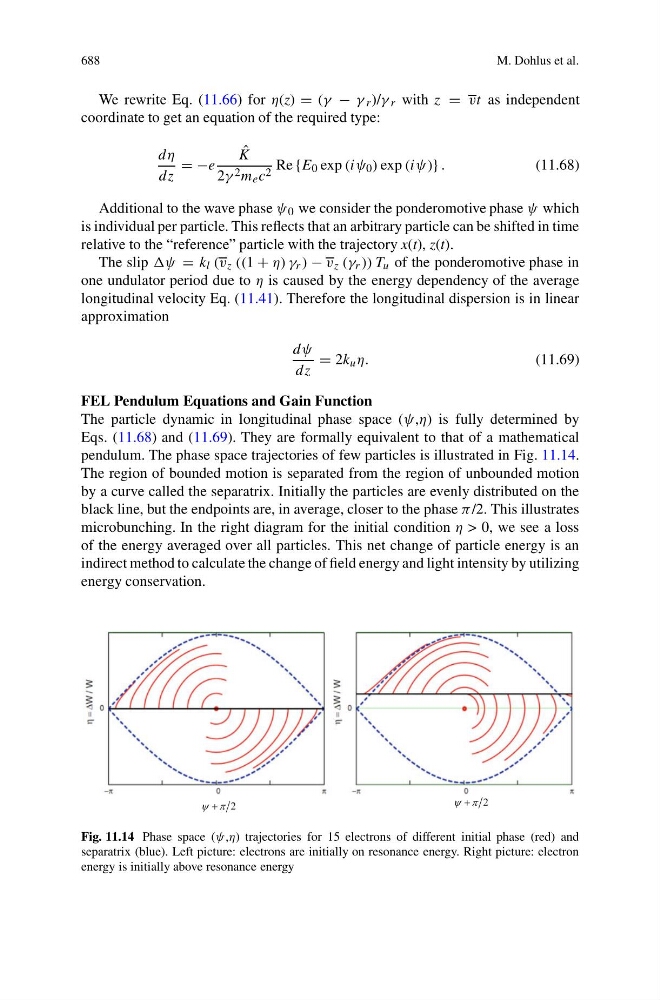
The particle dynamic in longitudinal phase space (ψ,η) is fully determined by
Eqs. (11.68) and (11.69). They are formally equivalent to that of a mathematical
pendulum. The phase space trajectories of few particles is illustrated in Fig. 11.14.
The region of bounded motion is separated from the region of unbounded motion
by a curve called the separatrix. Initially the particles are evenly distributed on the
black line, but the endpoints are, in average, closer to the phase π/2. This illustrates
microbunching. In the right diagram for the initial condition η > 0, we see a loss
of the energy averaged over all particles. This net change of particle energy is an
indirect method to calculate the change of field energy and light intensity by utilizing
energy conservation.
Fig. 11.14 Phase space (ψ,η) trajectories for 15 electrons of different initial phase (red) and
separatrix (blue). Left picture: electrons are initially on resonance energy. Right picture: electron
energy is initially above resonance energy