

11 Application of Accelerators and Storage Rings
687
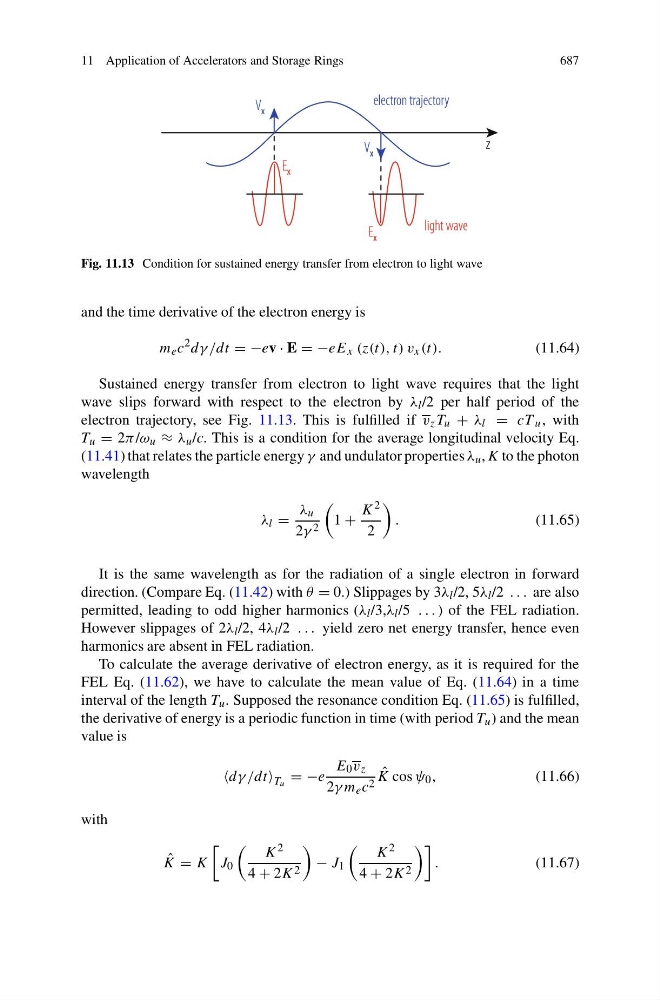
Fig. 11.13 Condition for sustained energy transfer from electron to light wave
and the time derivative of the electron energy is
m e c
2 dγ /dt = −ev · E = −eE x (z(t), t) v x (t).
(11.64)
Sustained energy transfer from electron to light wave requires that the light
wave slips forward with respect to the electron by λ l /2 per half period of the
electron trajectory, see Fig. 11.13. This is fulfilled if v z T u + λ l = cT u , with
T u = 2π/ω u ≈ λ u /c. This is a condition for the average longitudinal velocity Eq.
(11.41) that relates the particle energy γ and undulator properties λ u , K to the photon
wavelength
λ l =
λ u
2γ 2
1 +
K 2
2
.
(11.65)
It is the same wavelength as for the radiation of a single electron in forward
direction. (Compare Eq. (11.42) with θ = 0.) Slippages by 3λ l /2, 5λ l /2 . . . are also
permitted, leading to odd higher harmonics (λ l /3,λ l /5 . . . ) of the FEL radiation.
However slippages of 2λ l /2, 4λ l /2 . . . yield zero net energy transfer, hence even
harmonics are absent in FEL radiation.
To calculate the average derivative of electron energy, as it is required for the
FEL Eq. (11.62), we have to calculate the mean value of Eq. (11.64) in a time
interval of the length T u . Supposed the resonance condition Eq. (11.65) is fulfilled,
the derivative of energy is a periodic function in time (with period T u ) and the mean
value is
dγ /dt T u = −e
E 0 v z
2γ m e c 2
ˆ
K cos ψ 0 ,
(11.66)
with
ˆ
K = K
J 0
K 2
4 + 2K 2
− J 1
K 2
4 + 2K 2
.
(11.67)