

11 Application of Accelerators and Storage Rings
671
The factor of 2 appears since
− →
E (t) is a real quantity, such that negative
frequencies are not considered. According to Eq. (11.10), this means that the
expression
− →
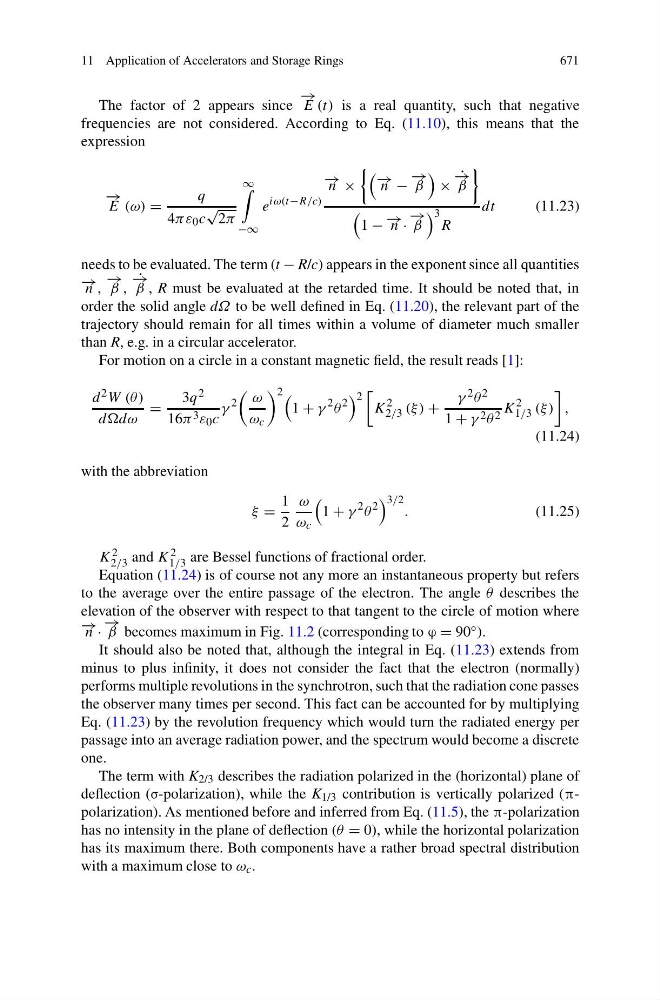
E (ω) =
q
4πε 0 c
√
2π
∞
−∞
e
iω(t−R/c)
− → n ×
− → n −
− →
β
×
˙
− →
β
1 − − → n ·
− →
β
3
R
dt
(11.23)
needs to be evaluated. The term (t − R/c) appears in the exponent since all quantities
− → n ,
− →
β ,
˙
− →
β , R must be evaluated at the retarded time. It should be noted that, in
order the solid angle dΩ to be well defined in Eq. (11.20), the relevant part of the
trajectory should remain for all times within a volume of diameter much smaller
than R, e.g. in a circular accelerator.
For motion on a circle in a constant magnetic field, the result reads [1]:
d 2 W (θ )
dddω
=
3q 2
16π 3 ε 0 c
γ
2
ω
ω c
2
1 + γ
2 θ
2
2
K
2
2/3 (ξ ) +
γ 2 θ 2
1 + γ 2 θ 2 K
2
1/3 (ξ )
,
(11.24)
with the abbreviation
ξ =
1
2
ω
ω c
1 + γ
2 θ
2
3/2
.
(11.25)
K 2
2/3 and K 2
1/3 are Bessel functions of fractional order.
Equation (11.24) is of course not any more an instantaneous property but refers
to the average over the entire passage of the electron. The angle θ describes the
elevation of the observer with respect to that tangent to the circle of motion where
− → n ·
− →
β becomes maximum in Fig. 11.2 (corresponding to ϕ = 90 ◦ ).
It should also be noted that, although the integral in Eq. (11.23) extends from
minus to plus infinity, it does not consider the fact that the electron (normally)
performs multiple revolutions in the synchrotron, such that the radiation cone passes
the observer many times per second. This fact can be accounted for by multiplying
Eq. (11.23) by the revolution frequency which would turn the radiated energy per
passage into an average radiation power, and the spectrum would become a discrete
one.
The term with K 2/3 describes the radiation polarized in the (horizontal) plane of
deflection (σ-polarization), while the K 1/3 contribution is vertically polarized (πpolarization). As mentioned before and inferred from Eq. (11.5), the π-polarization
has no intensity in the plane of deflection (θ = 0), while the horizontal polarization
has its maximum there. Both components have a rather broad spectral distribution
with a maximum close to ω c .