

670
M. Dohlus et al.
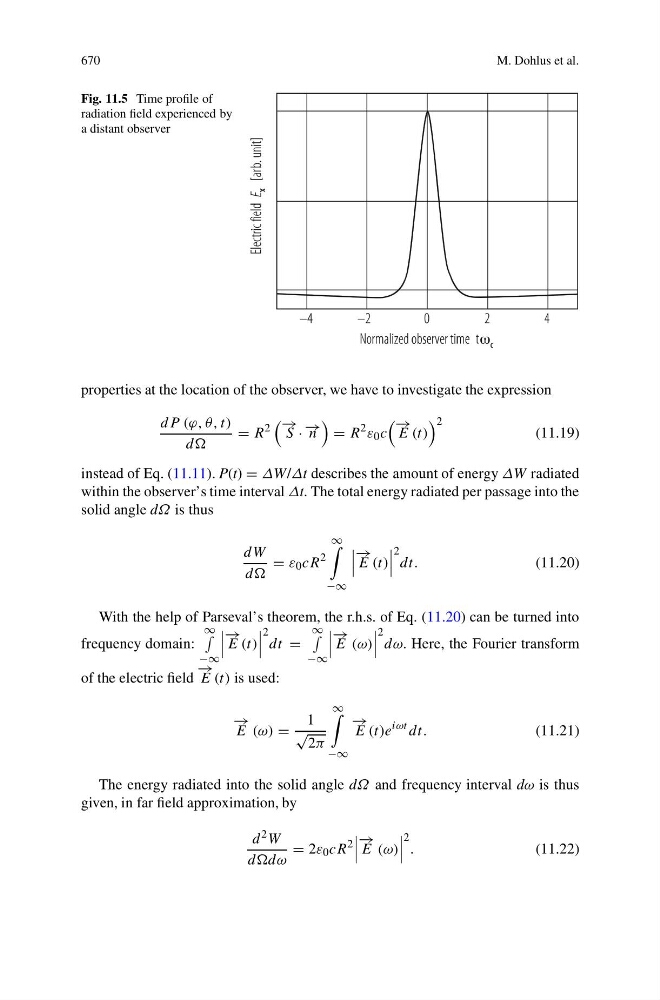
Fig. 11.5 Time profile of
radiation field experienced by
a distant observer
properties at the location of the observer, we have to investigate the expression
dP (ϕ, θ, t)
dd
= R
2
− →
S · − → n
= R
2 ε 0 c
− →
E (t)
2
(11.19)
instead of Eq. (11.11). P(t) = ΔW/Δt describes the amount of energy ΔW radiated
within the observer’s time interval Δt. The total energy radiated per passage into the
solid angle dΩ is thus
dW
dd
= ε 0 cR
2
∞
−∞
− →
E (t)
2
dt.
(11.20)
With the help of Parseval’s theorem, the r.h.s. of Eq. (11.20) can be turned into
frequency domain:
∞
−∞
− →
E (t)
2
dt =
∞
−∞
− →
E (ω)
2
dω. Here, the Fourier transform
of the electric field
− →
E (t) is used:
− →
E (ω) =
1
√
2π
∞
−∞
− →
E (t)e
iωt dt.
(11.21)
The energy radiated into the solid angle dΩ and frequency interval dω is thus
given, in far field approximation, by
d 2 W
dddω
= 2ε 0 cR
2
− →
E (ω)
2
.
(11.22)