

11 Application of Accelerators and Storage Rings
669
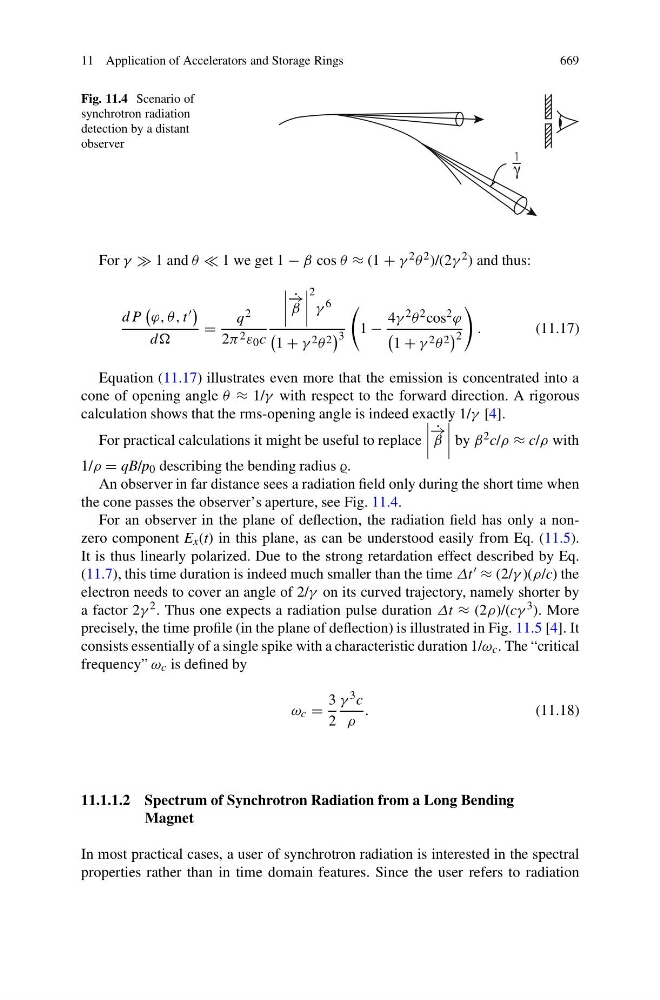
Fig. 11.4 Scenario of
synchrotron radiation
detection by a distant
observer
For γ 1 and θ 1 we get 1 − β cos θ ≈ (1 + γ 2 θ 2 )/(2γ 2 ) and thus:
dP
ϕ, θ, t
dd
=
q 2
2π 2 ε 0 c
˙
− →
β
2
γ 6
1 + γ 2 θ 2
3
1 −
4γ 2 θ 2 cos 2 ϕ
1 + γ 2 θ 2
2
.
(11.17)
Equation (11.17) illustrates even more that the emission is concentrated into a
cone of opening angle θ ≈ 1/γ with respect to the forward direction. A rigorous
calculation shows that the rms-opening angle is indeed exactly 1/γ [4].
For practical calculations it might be useful to replace
˙
− →
β
by β 2 c/ρ ≈ c/ρ with
1/ρ = qB/p 0 describing the bending radius
An observer in far distance sees a radiation field only during the short time when
the cone passes the observer’s aperture, see Fig. 11.4.
For an observer in the plane of deflection, the radiation field has only a nonzero component E x (t) in this plane, as can be understood easily from Eq. (11.5).
It is thus linearly polarized. Due to the strong retardation effect described by Eq.
(11.7), this time duration is indeed much smaller than the time Δt ≈ (2/γ )(ρ/c) the
electron needs to cover an angle of 2/γ on its curved trajectory, namely shorter by
a factor 2γ 2 . Thus one expects a radiation pulse duration Δt ≈ (2ρ)/(cγ 3 ). More
precisely, the time profile (in the plane of deflection) is illustrated in Fig. 11.5 [4]. It
consists essentially of a single spike with a characteristic duration 1/ω c . The “critical
frequency” ω c is defined by
ω c =
3
2
γ 3 c
ρ
.
(11.18)
11.1.1.2 Spectrum of Synchrotron Radiation from a Long Bending
Magnet
In most practical cases, a user of synchrotron radiation is interested in the spectral
properties rather than in time domain features. Since the user refers to radiation