

668
M. Dohlus et al.
0.3
0.2
0.1
–0.1
–0.2
–0.3
0.8
0.6
0.4
0.2
–0.2
–0.4
–0.6
–0.8
–1
–0.8
–0.6
–0.4
–0.2
0.2
0.4
0.6
0.8
0
0
0
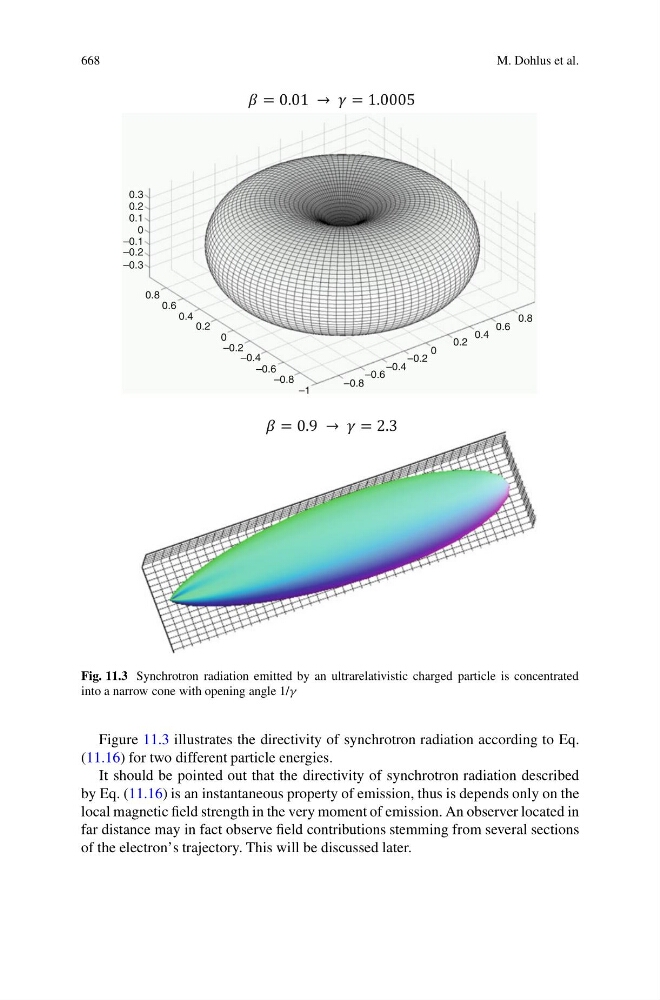
Fig. 11.3 Synchrotron radiation emitted by an ultrarelativistic charged particle is concentrated
into a narrow cone with opening angle 1/γ
Figure 11.3 illustrates the directivity of synchrotron radiation according to Eq.
(11.16) for two different particle energies.
It should be pointed out that the directivity of synchrotron radiation described
by Eq. (11.16) is an instantaneous property of emission, thus is depends only on the
local magnetic field strength in the very moment of emission. An observer located in
far distance may in fact observe field contributions stemming from several sections
of the electron’s trajectory. This will be discussed later.