

11 Application of Accelerators and Storage Rings
667
calculates
U rad =
1
c
P rad ds =
2ππ
c
P rad =
q 2
3ε 0
γ 4
ρ
≈ 88.5 keV
(E 0 /GeV)
4
ρ/m
,
(11.15)
where the integral extends over all bending magnets. The last expression represents
the radiation loss in practical units in the case of electrons or positrons, with E 0 the
particle energy. For simplicity is has been assumed that ρ is constant in all bending
magnets.
According to the γ 4 -scaling of Eqs. (11.13) and (11.15), synchrotron radiation
constitutes a massive challenge on the construction of electron/positron synchrotrons in the multi-GeV range. As an extreme example, in the electron-positron
storage ring LEP at CERN each particle lost approximately U rad = 2850 MeV per
turn when running at its maximum particle energy of E 0 = 100 GeV, even though
the bending radius was as large as ρ = 3100 m.
On the contrary, emission of synchrotron radiation is a negligible effect for
hadrons in most practical cases.
In a magnetic field, the acceleration is always perpendicular to the velocity:
˙
− →
β ⊥
− →
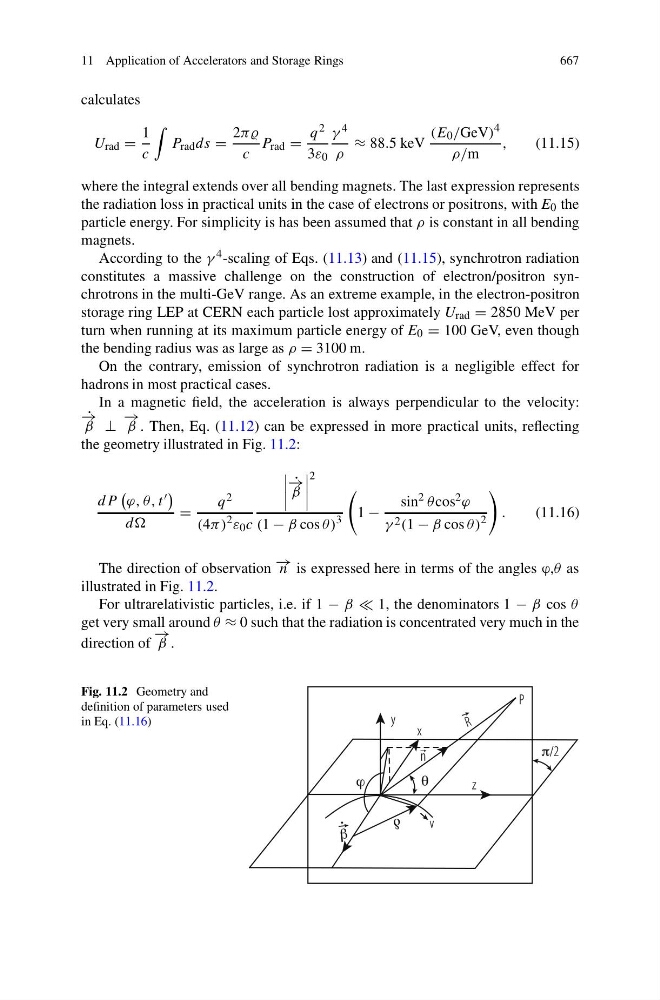
β . Then, Eq. (11.12) can be expressed in more practical units, reflecting
the geometry illustrated in Fig. 11.2:
dP
ϕ, θ, t
dd
=
q 2
(4π)
2 ε 0 c
˙
− →
β
2
(1 − β cos θ )
3
1 −
sin 2 θ cos 2 ϕ
γ 2 (1 − β cos θ )
2
.
(11.16)
The direction of observation − → n is expressed here in terms of the angles ϕ,θ as
illustrated in Fig. 11.2.
For ultrarelativistic particles, i.e. if 1 − β 1, the denominators 1 − β cos θ
get very small around θ ≈ 0 such that the radiation is concentrated very much in the
direction of
− →
β .
Fig. 11.2 Geometry and
definition of parameters used
in Eq. (11.16)