

666
M. Dohlus et al.
Radiation Power and Its Angular Distribution
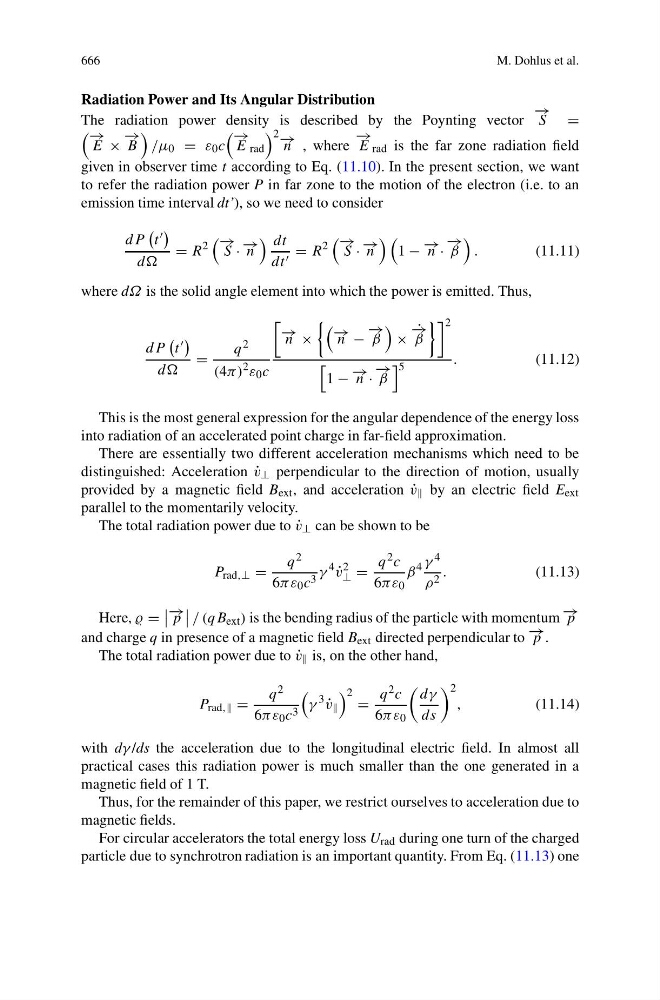
The radiation power density is described by the Poynting vector
− →
S =
− →
E ×
− →
B
/μ 0 = ε 0 c
− →
E rad
2 − → n , where
− →
E rad is the far zone radiation field
given in observer time t according to Eq. (11.10). In the present section, we want
to refer the radiation power P in far zone to the motion of the electron (i.e. to an
emission time interval dt’), so we need to consider
dP
t
dd
= R
2
− →
S · − → n
dt
dt = R
2
− →
S · − → n
1 − − → n ·
− →
β
.
(11.11)
where dΩ is the solid angle element into which the power is emitted. Thus,
dP
t
dd
=
q 2
(4π)
2 ε 0 c
− → n ×
− → n −
− →
β
×
˙
− →
β
2
1 − − → n ·
− →
β
5
.
(11.12)
This is the most general expression for the angular dependence of the energy loss
into radiation of an accelerated point charge in far-field approximation.
There are essentially two different acceleration mechanisms which need to be
distinguished: Acceleration ˙
v ⊥ perpendicular to the direction of motion, usually
provided by a magnetic field B ext , and acceleration ˙
v by an electric field E ext
parallel to the momentarily velocity.
The total radiation power due to ˙
v ⊥ can be shown to be
P rad,⊥ =
q 2
6πε 0 c 3 γ
4
˙
v
2
⊥ =
q 2 c
6πε 0
β
4 γ 4
ρ 2 .
(11.13)
Here, =
− → p
/ (qB ext ) is the bending radius of the particle with momentum − → p
and charge q in presence of a magnetic field B ext directed perpendicular to − → p .
The total radiation power due to ˙
v is, on the other hand,
P rad, =
q 2
6πε 0 c 3
γ
3
˙
v
2 =
q 2 c
6πε 0
dγ
ds
2
,
(11.14)
with dγ /ds the acceleration due to the longitudinal electric field. In almost all
practical cases this radiation power is much smaller than the one generated in a
magnetic field of 1 T.
Thus, for the remainder of this paper, we restrict ourselves to acceleration due to
magnetic fields.
For circular accelerators the total energy loss U rad during one turn of the charged
particle due to synchrotron radiation is an important quantity. From Eq. (11.13) one