

672
M. Dohlus et al.
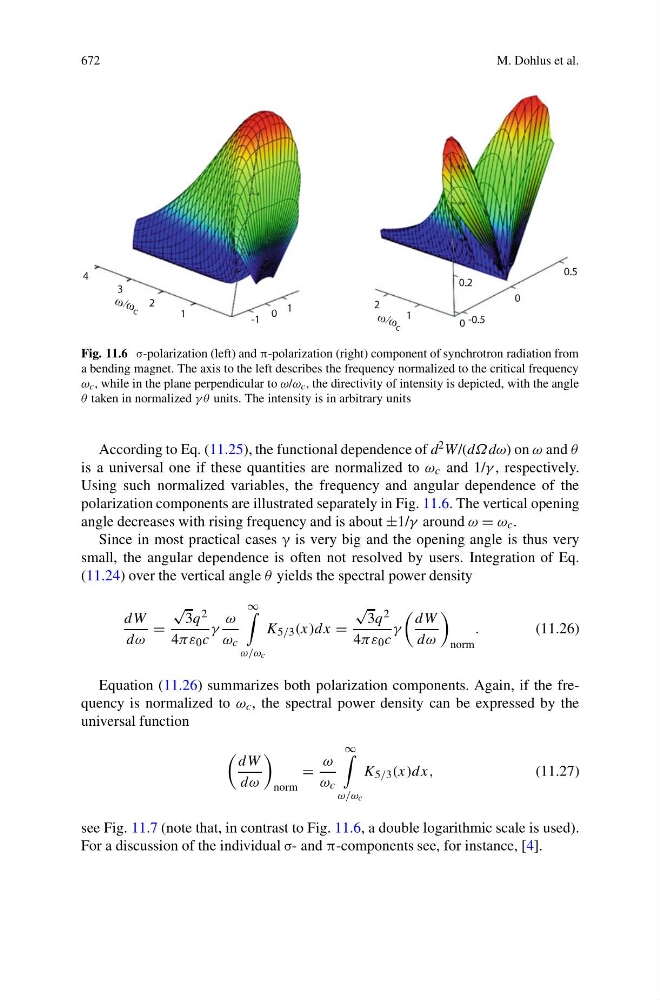
Fig. 11.6 σ-polarization (left) and π-polarization (right) component of synchrotron radiation from
a bending magnet. The axis to the left describes the frequency normalized to the critical frequency
ω c , while in the plane perpendicular to ω/ω c , the directivity of intensity is depicted, with the angle
θ taken in normalized γ θ units. The intensity is in arbitrary units
According to Eq. (11.25), the functional dependence of d 2 W/(dΩdω) on ω and θ
is a universal one if these quantities are normalized to ω c and 1/γ , respectively.
Using such normalized variables, the frequency and angular dependence of the
polarization components are illustrated separately in Fig. 11.6. The vertical opening
angle decreases with rising frequency and is about ±1/γ around ω = ω c .
Since in most practical cases γ is very big and the opening angle is thus very
small, the angular dependence is often not resolved by users. Integration of Eq.
(11.24) over the vertical angle θ yields the spectral power density
dW
dω
=
√
3q 2
4πε 0 c
γ
ω
ω c
∞
ω/ω c
K 5/3 (x)dx =
√
3q 2
4πε 0 c
γ
dW
dω
norm
.
(11.26)
Equation (11.26) summarizes both polarization components. Again, if the frequency is normalized to ω c , the spectral power density can be expressed by the
universal function
dW
dω
norm
=
ω
ω c
∞
ω/ω c
K 5/3 (x)dx,
(11.27)
see Fig. 11.7 (note that, in contrast to Fig. 11.6, a double logarithmic scale is used).
For a discussion of the individual σ- and π-components see, for instance, [4].